

Whether you’re opening a bank account, onboarding with a new employer, or accessing government services, identity verification Australia requirements will apply to you. Understanding how the system works, and what documents you’ll need, saves time and prevents frustration when you’re asked to prove who you are.
The 100-point ID check has been the backbone of identity verification in Australia for decades, requiring you to present a combination of documents that collectively reach 100 points. More recently, myID (formerly myGovID) has introduced a digital alternative, allowing Australians to verify their identity once and use it across multiple government services.
This guide walks you through both methods: the documents accepted under the traditional 100-point system and how to set up and use myID for secure digital access. At StackGo, we help businesses streamline their client onboarding by integrating identity verification directly into existing software, so understanding these requirements from both sides of the process matters. Let’s break down exactly what you need to know.
What identity verification means in Australia
Identity verification in Australia refers to the process of proving you are who you claim to be using official documents or digital credentials. When you interact with financial institutions, government agencies, or regulated businesses, they need to confirm your identity meets Australian legal standards before they can provide services to you.
Why Australia requires identity checks
Australia enforces strict identity verification laws to prevent fraud, money laundering, and identity theft. The primary legislation driving these requirements is the Anti-Money Laundering and Counter-Terrorism Financing (AML/CTF) Act 2006, which applies to banks, accountants, lawyers, real estate agents, and other regulated entities. These businesses face significant penalties if they fail to verify customer identities properly.
The AML/CTF Act doesn’t just protect institutions; it protects you by making it harder for criminals to use stolen or fake identities in the financial system.
Beyond financial crime prevention, government services require identity verification to ensure only authorised individuals access sensitive personal information or benefits. Your health records, tax data, and Centrelink entitlements all sit behind identity checks that confirm you’re the rightful account holder.
The two main systems
You’ll encounter two distinct approaches when identity verification australia processes ask you to prove who you are. The traditional 100-point check requires you to present physical or certified documents that collectively score 100 points based on a standardised scale. Each document type carries a specific point value depending on how reliable authorities consider it.
The digital alternative, myID, allows you to verify your identity once through the Australian Taxation Office’s systems and then reuse that verified identity across multiple government services. This method eliminates the need to repeatedly present documents every time you interact with a new agency or service.
Step 1. Pick the verification method you need
Your first decision is determining which identity verification australia pathway applies to your situation. The method you choose depends on who’s requesting verification and what services you’re trying to access. Getting this right from the start prevents you from gathering unnecessary documents or setting up systems you won’t use.
Match your situation to the right method
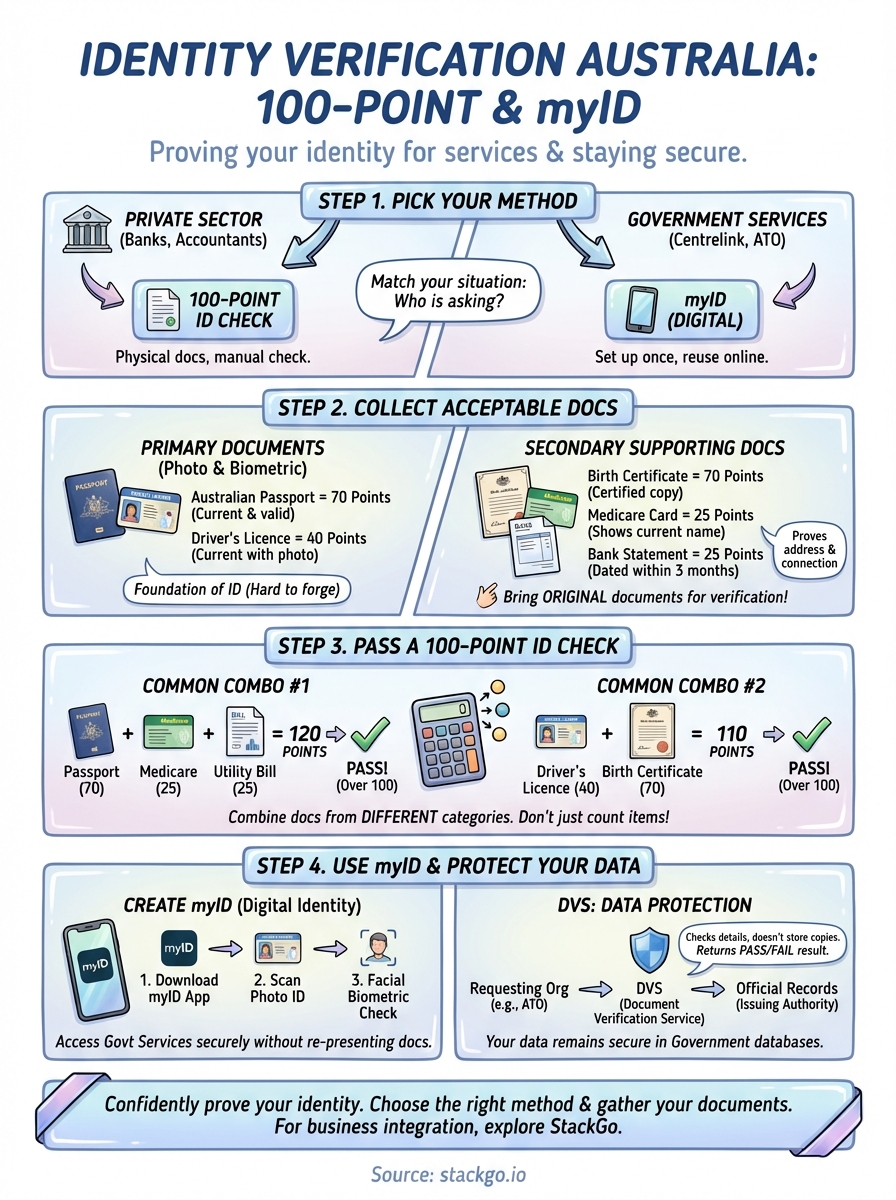
Private sector services like banks, accountants, lawyers, and real estate agents typically require the traditional 100-point ID check. These businesses need to verify your identity under AML/CTF legislation but don’t have direct access to the government’s digital verification systems. You’ll present physical documents or certified copies that their staff will examine and record.
Government services increasingly accept myID as your primary verification method. If you’re accessing Centrelink, Medicare, the Australian Taxation Office, or myGov services, setting up myID once gives you ongoing access without repeatedly proving your identity.
Choose myID if you regularly interact with government agencies; choose the 100-point check if you’re dealing with private businesses that don’t accept digital credentials.
Some organisations now accept both methods, particularly those that operate in regulated industries but also integrate with government systems. Always confirm which method your specific organisation requires before you start gathering documents, as mixing the two approaches wastes time and creates confusion.
Step 2. Collect acceptable ID documents
Understanding which documents qualify for identity verification australia processes saves you from wasting time gathering items that won’t be accepted. The 100-point check system divides documents into categories based on reliability, with each document assigned a specific point value. You need to gather enough documents from the accepted categories to reach the required threshold.
Primary identity documents
Primary documents carry the highest point values because they include photo identification and biometric data issued by government authorities. Your Australian passport scores 70 points and remains the single most valuable document in the system. If you hold a current passport, this document alone gets you most of the way to 100 points.
Your driver’s licence issued by an Australian state or territory scores 40 points when current and includes your photo. Most people rely on their driver’s licence as their primary identification document because it’s accessible and widely accepted across all verification scenarios.
Primary documents form the foundation of your identity verification because they include security features that make them difficult to forge or alter.
Secondary supporting documents
Secondary documents fill the remaining points needed after you present your primary identification. These documents typically lack photos but prove your connection to an Australian address and financial system. Birth certificates score 70 points, but you’ll need to present a certified copy rather than the original in most situations.
Medicare cards score 25 points, bank statements or utility bills score 25 points each, and Centrelink or Department of Veterans’ Affairs cards score 25 points. Financial institutions typically require at least one document showing your current residential address alongside your photo identification, which means recent bank statements or utility bills dated within the last three months become essential supporting documents.
Step 3. Pass a 100-point ID check
Reaching the 100-point threshold requires you to strategically combine documents from different categories. The system doesn’t simply count how many documents you present; it assigns specific point values to each document type based on its reliability and security features. Understanding which combinations work prevents you from arriving unprepared or presenting insufficient identification.
Calculate your document points
Common document combinations that reach 100 points include your Australian passport (70 points) plus a Medicare card (25 points) and a recent utility bill (25 points), totaling 120 points. Alternatively, your driver’s licence (40 points) combined with your birth certificate (70 points) exceeds the threshold at 110 points.
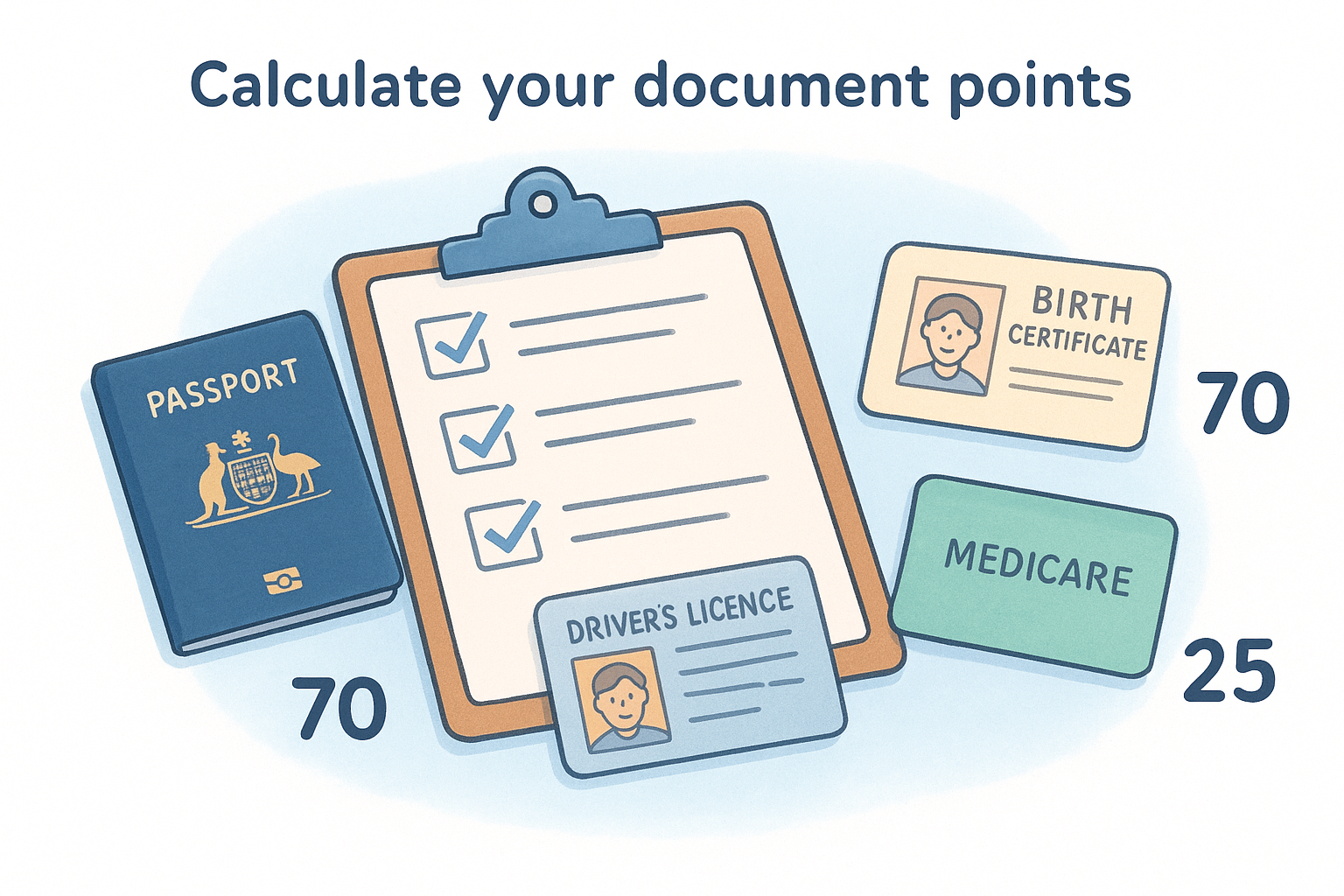
| Document Type | Points | Notes |
|---|---|---|
| Australian passport | 70 | Current and valid |
| Birth certificate | 70 | Certified copy |
| Driver’s licence | 40 | Current with photo |
| Medicare card | 25 | Shows current name |
| Bank statement | 25 | Dated within 3 months |
You need documents from at least two different categories, so presenting three bank statements won’t satisfy the requirement even if the points add up.
Present your documents correctly
Bring original documents to your verification appointment unless the organisation specifically requests certified copies. Financial institutions and government agencies examine originals to verify security features like holograms and watermarks that don’t appear clearly on photocopies. Most verifiers will photocopy or scan your originals and return them immediately during your appointment.
Step 4. Use myID and DVS and protect your data
Setting up myID eliminates repetitive document presentation when you access multiple government services. The Document Verification Service (DVS) works behind the scenes to verify your documents against official records, while your personal data remains protected through strict privacy controls built into the Australian government’s verification infrastructure.
Create your myID digital identity
Download the myID app from the Australian Taxation Office through the App Store or Google Play Store. The app guides you through scanning your driver’s licence or passport using your phone’s camera, then asks you to complete a facial biometric check that matches your photo against the document you’ve scanned.
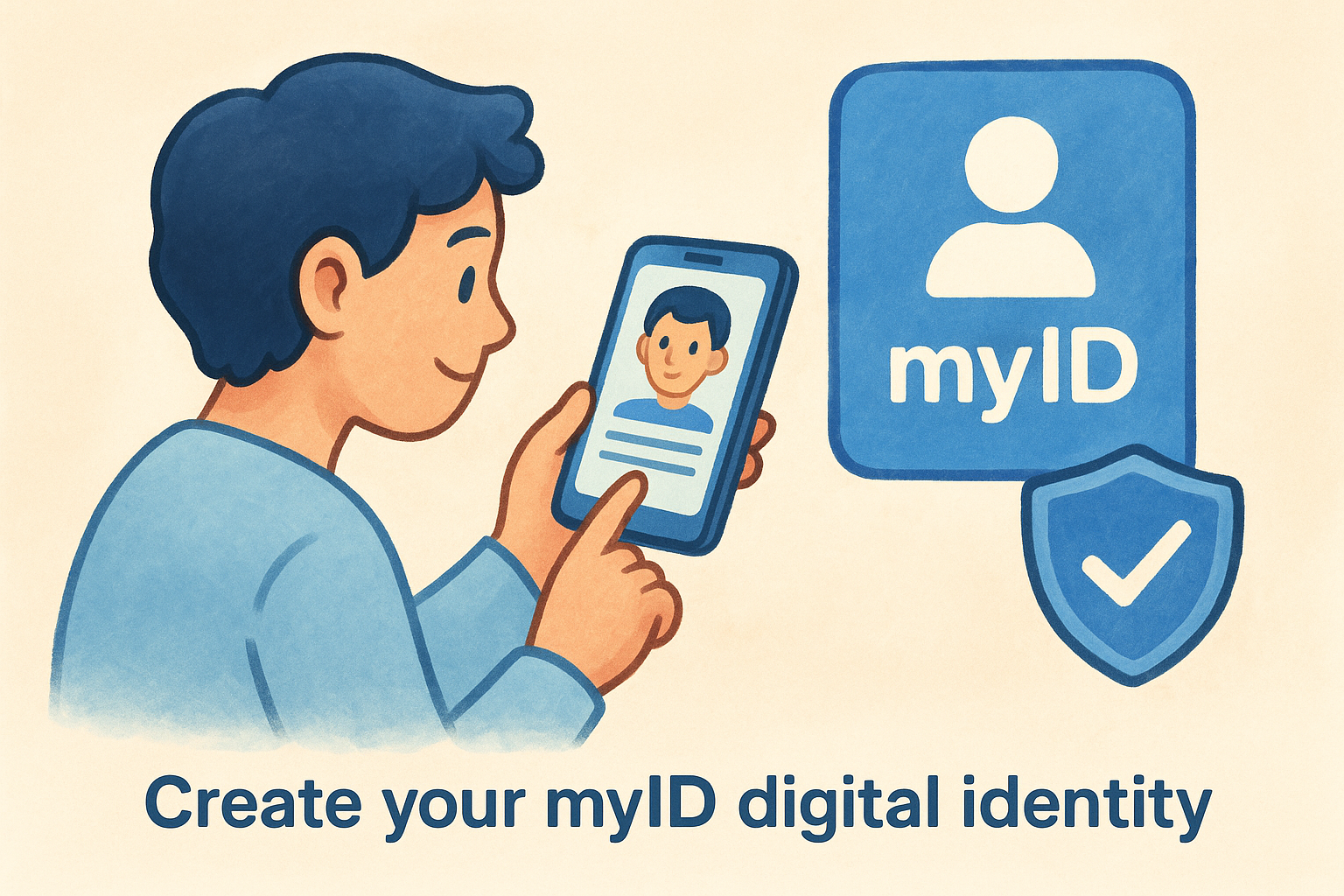
Once verified, your myID gives you access to Medicare, Centrelink, the ATO, and myGov without presenting documents again.
The setup process takes approximately five to ten minutes and requires you to answer security questions about your tax or Centrelink history to confirm your identity against government records.
Understand how DVS protects your information
The Document Verification Service checks your document details against issuing authorities like state transport departments or the Department of Foreign Affairs without storing copies of your actual documents. Your identity verification australia data never sits in the verifier’s system; DVS returns only a pass or fail result to the requesting organisation, keeping your personal information secure within government-controlled databases.
Where to go from here
You now understand both the 100-point ID check and myID systems that power identity verification australia processes. When you need to prove your identity to banks, accountants, government agencies, or other regulated businesses, you can confidently present the right documents in the correct combinations.
For businesses handling client onboarding and identity verification, the manual checking process creates bottlenecks and increases error rates. StackGo’s IdentityCheck integrates AUSTRAC Tranche 2 AML/CTF compliance directly into your existing CRM or accounting software, eliminating separate verification tabs and reducing verification time from minutes to seconds. Your staff verify identities without leaving the systems they already use daily.
Start by identifying which verification method your immediate situation requires, gather your documents using the combinations outlined above, and keep your myID credentials updated for ongoing government service access.


