

Staying compliant used to mean spreadsheets, manual checklists, and hoping nothing slipped through the cracks. For accounting firms navigating TPB requirements or preparing for AUSTRAC’s AML/CTF regime, that approach no longer cuts it. An automated compliance management system removes the guesswork by handling audits, risk assessments, and regulatory workflows without constant manual oversight. The result? Fewer errors, faster processes, and more time to focus on clients instead of paperwork.
But not all compliance tools are built the same. Some require you to learn entirely new platforms, others struggle to connect with your existing software, and a few promise automation but deliver little more than glorified task lists. Choosing the right system means finding one that fits your current tech stack and actually reduces your workload rather than adding to it.
This guide breaks down six of the best automated compliance management tools available in 2026. Whether you need identity verification, document management, or end-to-end regulatory tracking, you’ll find options here that integrate with platforms you already use, including solutions like StackGo’s IdentityCheck, which brings KYC/AML verification directly into your CRM without the usual integration headaches.
1. StackGo IdentityCheck
StackGo IdentityCheck brings KYC/AML verification directly into your CRM, which means you don’t need to open separate software or copy-paste client details between platforms. The system reads contact information from your existing CRM, verifies identities against global databases, and writes the results back automatically. You get compliance without the usual platform-switching headaches that slow down onboarding workflows.

What it automates and how it works
IdentityCheck automates the entire identity verification process within your CRM by pulling contact data, verifying it against over 10,000 document types across 200+ countries, and recording outcomes directly in the contact record. You don’t build custom automations or manage API connections because the integration works as a native CRM extension. The system handles document verification, liveness checks, and AML screening without requiring your team to leave their daily workspace.
"StackGo’s integration design eliminates the need for learning new software, managing multiple tabs, or building complex custom automations."
Compliance and security approach for PII
Your PII never touches the CRM database because IdentityCheck uses a dedicated privacy layer that stores sensitive information separately. Only admins with MFA authentication can access this data, which keeps you compliant with privacy regulations while still allowing verification workflows to run smoothly. The system processes identity checks without exposing personal details to your broader team or CRM storage.
Integrations and workflow fit
IdentityCheck integrates with HubSpot, Salesforce, and other major CRMs as a productised solution rather than a custom build. You install the integration once and verification workflows become part of your standard contact management process. This approach works for firms that want automated compliance management system functionality without the complexity of Zapier-style connections or standalone platforms.
Best fit in Australia
Australian accounting firms preparing for AUSTRAC AML/CTF requirements or managing TPB compliance find IdentityCheck particularly useful because it handles identity verification at the point of contact creation. The system supports Australian regulatory standards while covering global clients, which matters if your firm works with international entities or overseas structures.
Pricing model
You pay per verification check rather than a flat subscription, which means costs scale with actual usage. Small firms running occasional verifications won’t pay for unused capacity, while larger practices can process high volumes without platform limitations. Pricing details come through direct consultation based on your expected verification volume.
2. Vanta
Vanta automates security compliance frameworks like SOC 2, ISO 27001, and GDPR by continuously monitoring your infrastructure and collecting evidence without manual data gathering. The platform connects to your cloud services, HR systems, and development tools to track security controls in real time, which means you spend less time preparing for audits and more time running your business.
What it automates and how it works
The system automatically monitors over 30 security controls across your technology stack by integrating with services like AWS, Google Cloud, and GitHub. Vanta collects evidence for compliance requirements, tracks policy changes, and alerts you when controls drift out of alignment. You get a centralised dashboard that shows your compliance status across multiple frameworks simultaneously.
"Vanta’s continuous monitoring approach means compliance isn’t a once-a-year scramble but an ongoing automated process."
Compliance and security approach for PII
Vanta tracks how your systems handle sensitive data by monitoring access controls, encryption standards, and data retention policies. The platform doesn’t store your actual PII but instead verifies that your infrastructure meets framework requirements for data protection. This approach keeps compliance documentation separate from the data itself.
Integrations and workflow fit
You connect Vanta to your existing tech stack through pre-built integrations rather than custom API work. The platform works with major cloud providers, identity management systems, and communication tools. This makes it suitable for teams already using standard SaaS infrastructure but less ideal if your compliance needs require CRM-native workflows.
Best fit in Australia
Australian businesses seeking international security certifications find Vanta useful when working with overseas clients who require SOC 2 or ISO 27001 compliance. The platform focuses on security frameworks rather than Australian-specific regulations like AUSTRAC requirements.
Pricing model
Vanta charges annual subscriptions based on your company size and which compliance frameworks you need. Pricing starts around several thousand dollars per year, with costs increasing for multiple framework coverage or larger organisations.
3. Drata
Drata operates as an automated compliance management system that continuously monitors your security posture across multiple frameworks including SOC 2, ISO 27001, HIPAA, and GDPR. The platform connects directly to your infrastructure to collect compliance evidence automatically, which removes the manual spreadsheet work that typically bogs down audit preparation. You get real-time visibility into your compliance status without assigning someone to chase down documentation every quarter.
What it automates and how it works
The platform automatically tracks compliance controls by monitoring your cloud infrastructure, employee access patterns, and security policies through pre-built integrations. Drata collects evidence for audit requirements, maps controls to specific framework standards, and generates reports that auditors can use directly. You don’t manually gather screenshots or documentation because the system pulls this information from your connected services as changes occur.
Compliance and security approach for PII
Drata monitors how your systems handle sensitive data by checking encryption protocols, access logging, and retention policies without storing the actual PII. The platform verifies that your data protection measures meet framework requirements and flags gaps when controls don’t align with compliance standards. This approach keeps your sensitive information in its original systems while proving you’re handling it correctly.
Integrations and workflow fit
You connect Drata to your existing technology stack through integrations with cloud providers, identity management platforms, and communication tools. The system works alongside your current infrastructure rather than replacing it, which suits teams running standard SaaS environments. However, it operates as a separate compliance platform rather than embedding directly into tools like your CRM.
Best fit in Australia
Australian businesses pursuing international compliance certifications for work with global clients find Drata useful when SOC 2 or ISO 27001 requirements come up. The platform focuses on these security frameworks rather than Australian-specific regulations like TPB or AUSTRAC compliance.
Pricing model
Drata charges annual subscriptions based on your employee count and which compliance frameworks you need covered. Pricing typically starts at several thousand dollars per year and scales with company size.
"Drata’s automated evidence collection turns audit preparation from a months-long project into an ongoing background process."
4. Secureframe
Secureframe provides an automated compliance management system that continuously monitors your security controls across frameworks like SOC 2, ISO 27001, PCI DSS, and HIPAA. The platform connects to your infrastructure and automatically collects evidence for compliance requirements, which means you spend less time preparing audit documentation and more time maintaining actual security. You get a unified view of your compliance posture without manually tracking controls across multiple systems.
What it automates and how it works
The platform automatically monitors security controls by connecting to your cloud services, HR platforms, and development tools to collect compliance evidence as your systems operate. Secureframe maps these controls to specific framework requirements and generates audit-ready reports that show which standards you meet. The system flags control gaps in real time and provides remediation guidance when issues appear.
Compliance and security approach for PII
Secureframe verifies your data handling practices by monitoring encryption standards, access controls, and retention policies without storing your actual sensitive information. The platform tracks how you protect PII and ensures your security measures align with framework requirements. This approach proves compliance while keeping your data in its original systems.
"Secureframe’s real-time control monitoring transforms compliance from a periodic project into an ongoing automated process."
Integrations and workflow fit
You connect Secureframe to your existing technology infrastructure through pre-built integrations with major cloud providers and business tools. The system operates as a separate compliance platform rather than embedding into your CRM or daily workflow tools, which works for teams managing infrastructure-level compliance requirements.
Best fit in Australia
Australian businesses seeking international security certifications for global partnerships find Secureframe useful when clients require SOC 2 or ISO 27001 compliance. The platform focuses on these security frameworks rather than Australian-specific regulations like AUSTRAC or TPB requirements.
Pricing model
Secureframe charges annual subscriptions based on company size and framework coverage needed. Pricing typically begins at several thousand dollars annually and increases with additional frameworks or employee count.
5. Hyperproof
Hyperproof functions as a compliance operations platform that centralises your audit preparation, risk management, and control monitoring across multiple frameworks including SOC 2, ISO 27001, GDPR, and NIST. The platform automatically collects evidence from your connected systems and organises it into audit-ready documentation, which removes the manual work of gathering compliance proof every quarter. You get a single workspace where your team can track requirements, assign tasks, and maintain evidence without juggling spreadsheets.
What it automates and how it works
The platform automatically pulls evidence from your technology stack through integrations with cloud services and business applications. Hyperproof maps this evidence to specific compliance requirements across different frameworks and maintains an ongoing record of your control effectiveness. The system alerts you when evidence expires or controls need updating.
Compliance and security approach for PII
Hyperproof tracks your data protection measures by monitoring how you implement security controls without storing the actual sensitive information. The platform verifies that your privacy practices meet framework standards and documents your compliance posture for auditors.
Integrations and workflow fit
You connect Hyperproof to your existing infrastructure through pre-built integrations with major cloud platforms and business tools. The system operates as a dedicated compliance workspace rather than embedding into your CRM or daily operational software.
"Hyperproof’s centralised evidence management turns scattered compliance documentation into an organised, auditable system."
Best fit in Australia
Australian businesses managing multiple compliance frameworks simultaneously find Hyperproof useful for coordinating requirements across different standards. The platform handles security certifications rather than Australian-specific regulations.
Pricing model
Hyperproof charges subscription fees based on user count and framework coverage, with pricing available through direct sales consultation.
6. LogicGate Risk Cloud
LogicGate Risk Cloud operates as a customisable compliance and risk management platform that adapts to your specific regulatory requirements rather than forcing you into predefined frameworks. The platform lets you build custom workflows for risk assessments, policy management, and audit tracking, which works well if your compliance needs extend beyond standard certifications. You get flexibility to structure your compliance processes without being locked into rigid framework templates.
What it automates and how it works
The platform automates risk assessments and control monitoring through configurable workflows that you design based on your requirements. LogicGate collects data from various sources, tracks remediation progress, and generates compliance reports tailored to your specific needs. The system adapts to different regulatory environments rather than focusing solely on security frameworks.
Compliance and security approach for PII
LogicGate manages your compliance documentation and risk registers while allowing you to define how sensitive information gets handled. The platform tracks control effectiveness and policy adherence according to the standards you set rather than enforcing a single approach.
Integrations and workflow fit
You connect LogicGate to your technology stack through API integrations and data imports. The system operates as a standalone platform for compliance management rather than embedding into your CRM or daily operational tools.
"LogicGate’s customisable approach suits organisations with unique compliance requirements that don’t fit standard framework templates."
Best fit in Australia
Australian businesses managing diverse regulatory requirements across multiple jurisdictions find LogicGate useful when standard automated compliance management system tools don’t cover their specific needs.
Pricing model
LogicGate charges subscription fees based on user count and platform features, with pricing available through direct sales consultation.
Next steps
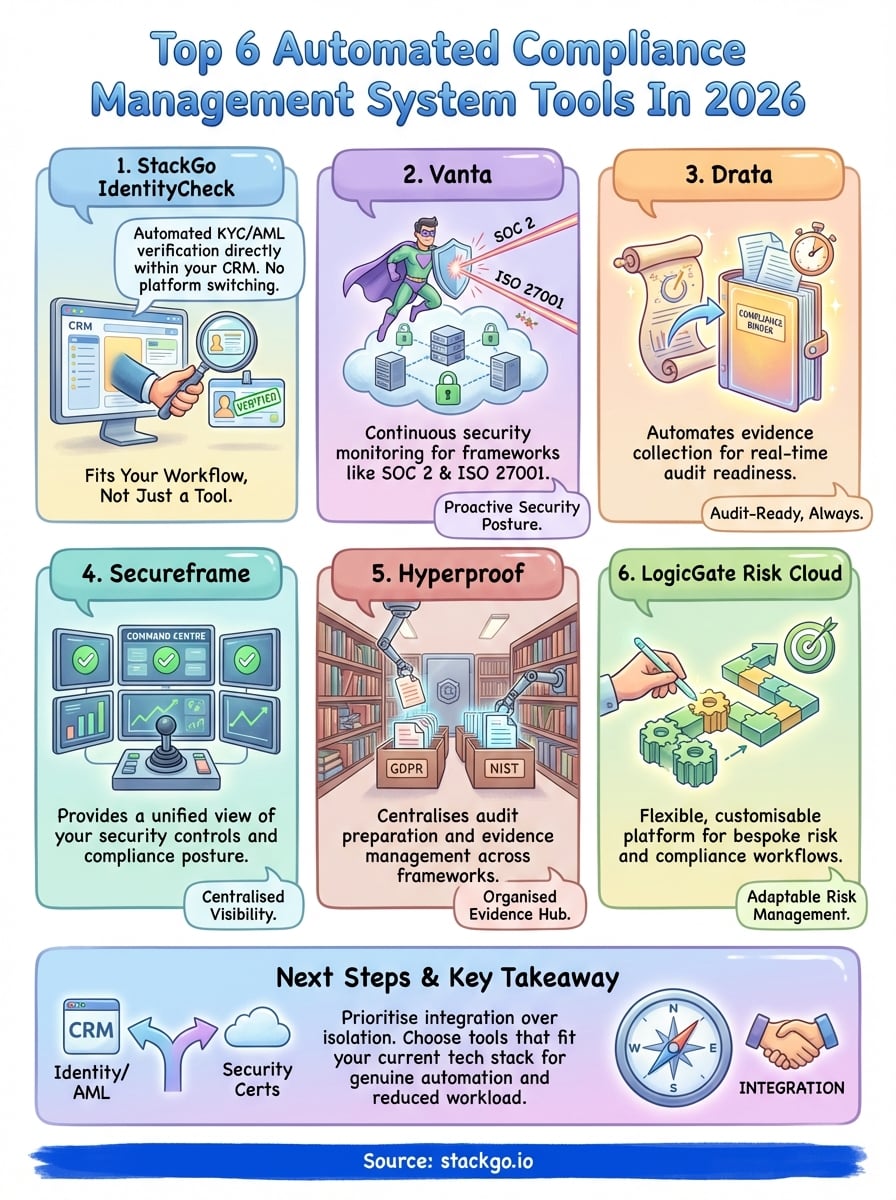
Choosing an automated compliance management system comes down to where you need the automation to happen. If your compliance requirements revolve around security certifications like SOC 2 or ISO 27001, platforms like Vanta or Drata handle the infrastructure monitoring. If you need identity verification and AML/CTF compliance built directly into your CRM workflow, StackGo IdentityCheck removes the platform-switching entirely.
Your decision should prioritise integration over isolation. Tools that work within your existing software stack reduce training time, eliminate double-handling, and actually get used by your team. Standalone platforms often create more administrative overhead rather than less, particularly when you’re managing client onboarding and verification processes daily.
Australian accounting firms preparing for AUSTRAC Tranche 2 AML/CTF requirements need solutions that handle identity checks without disrupting established workflows. Testing platforms with your actual client data and existing systems shows you which tools deliver genuine automation rather than just adding another login to manage.


