

Getting customer onboarding right determines whether new clients become long-term partners or churn within months. A solid customer onboarding checklist gives your team a repeatable framework to welcome clients, verify their identity, gather required documentation, and demonstrate value, without dropping the ball on compliance or critical steps.
For regulated businesses, accountants, financial services, legal firms, onboarding involves more than a welcome email. You need to verify identities, meet KYC/AML requirements, and document everything properly. Miss a step, and you’re facing compliance headaches or, worse, regulatory penalties.
At StackGo, we build integration tools that streamline onboarding workflows directly within your existing CRM, including identity verification that reads contact data, runs checks, and writes outcomes back automatically. We’ve seen firsthand how a structured checklist, combined with the right automation, transforms chaotic onboarding into a reliable, repeatable process.
This guide walks you through building your own customer onboarding checklist, complete with templates, key steps, and KPIs to measure success. Whether you’re creating a process from scratch or optimising an existing one, you’ll find practical frameworks you can implement immediately.
What a customer onboarding checklist should cover
A customer onboarding checklist functions as your team’s playbook for converting signed contracts into active, successful clients. Your checklist needs to capture every task, verification step, and milestone required to get clients up and running while meeting compliance obligations. Without this structure, critical steps get missed, handoffs fail, and clients experience confusion instead of confidence.
Your checklist should break down into distinct phases with clear ownership assigned to each task. You want to avoid the common trap of creating a checklist that’s either too vague to be useful or so detailed it becomes overwhelming. The right balance ensures your team knows exactly what to do next, while giving you visibility into where clients sit in the onboarding journey.
Client information and verification requirements
Start your checklist with identity verification and compliance documentation. For regulated businesses, this means capturing full legal names, dates of birth, addresses, identification documents, and running KYC/AML checks before the client can fully engage with your services. You need to document the verification method used, the outcome, and when the check was completed.
Your checklist should specify what documents you need from clients, the acceptable document types for your jurisdiction, and the deadline for submission. For accountants and financial services firms, this typically includes proof of identity, proof of address, and business registration documents for corporate clients. You also want to track whether documents have been received, reviewed, and approved, so nothing sits in someone’s inbox unprocessed.
Regulated businesses that fail to verify client identity within required timeframes face penalties ranging from fines to licence suspension, making this the most critical section of your onboarding checklist.
Technical setup and access provisioning
Document every system, platform, and tool the client needs access to during onboarding. Your checklist should include creating user accounts, setting permissions, configuring integrations, and sending login credentials. You want to track whether the client has successfully logged in for the first time, as this indicates they’ve received credentials and can actually access your platform.
For businesses using CRM systems or client portals, this section covers data migration from legacy systems, importing historical records, and verifying data accuracy. Your checklist needs to include test transactions or sample runs to confirm integrations are working correctly before you push anything to production.
Timeline, milestones, and ownership tracking
Break your onboarding process into measurable milestones with target completion dates. Your checklist should show who owns each task, whether it’s your team member, the client, or a third-party provider. This prevents the "I thought you were handling that" scenario that derails onboarding.
Include decision points where you need client approval or input before proceeding. Your checklist should flag tasks that are time-sensitive, such as verification checks with expiry dates or regulatory deadlines. You also want to track client responsiveness, as slow responses often indicate confusion or lack of engagement that needs addressing.
Build in review checkpoints where your team confirms completed tasks meet quality standards before moving forward. Your checklist should include space for notes on issues encountered and how they were resolved, creating a knowledge base for future onboarding improvements.
Step 1. Define success, roles, and milestones
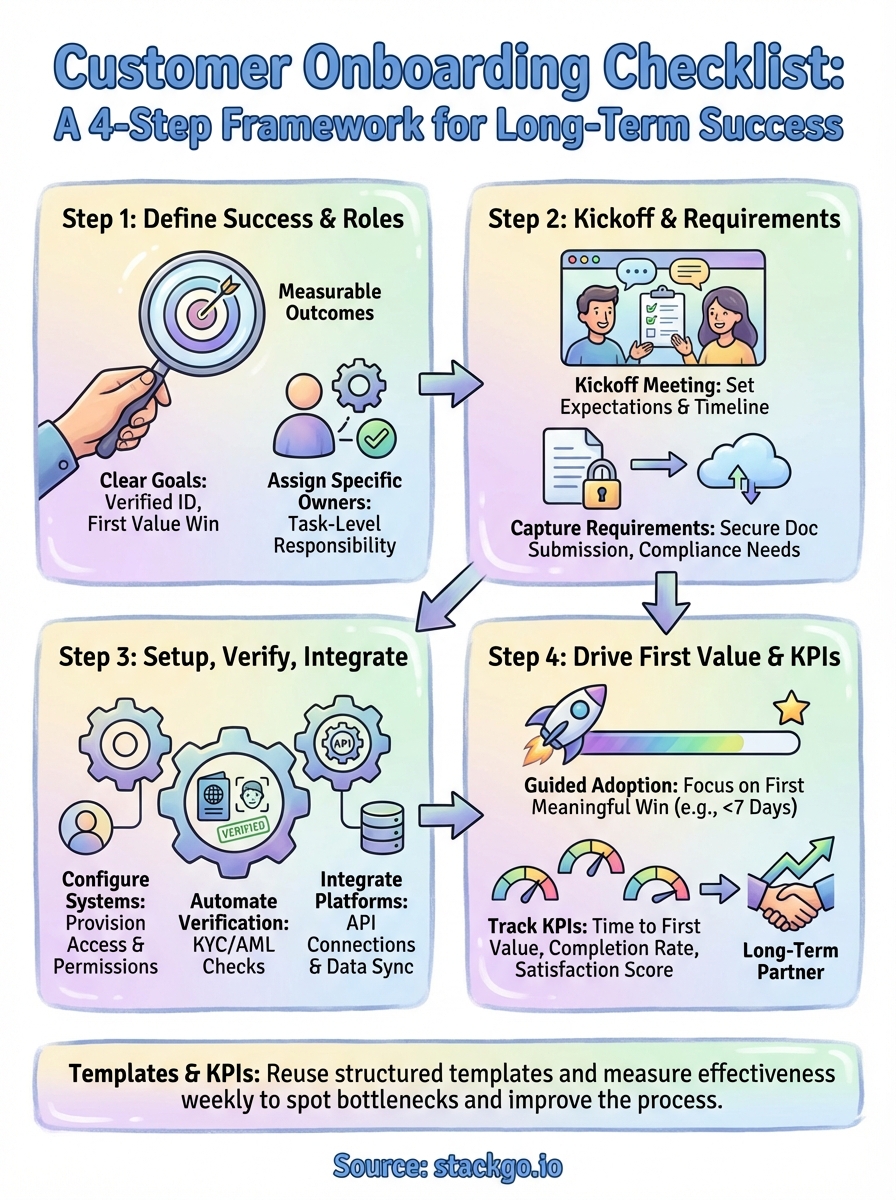
Before building your customer onboarding checklist, you need to establish what success looks like for both your team and your clients. Vague goals like "complete onboarding" don’t give you actionable targets or help you identify problems early. You want specific, measurable outcomes tied to client activation and compliance completion that everyone on your team understands.
Start by documenting the end state you’re aiming for: verified client identity, approved documentation, configured system access, and the client achieving their first meaningful outcome with your service. Your definitions need to be specific enough that two different team members would reach the same conclusion about whether a client has successfully completed onboarding.
Map customer success outcomes to measurable goals
Define what "activated client" means for your business in concrete terms. For accountants, this might mean verified identity, signed engagement letter, completed client questionnaire, and first tax return lodged. For financial advisors, it could be KYC/AML checks passed, risk profile completed, portfolio established, and first investment executed.
Your customer onboarding checklist should include metrics for each milestone: days to complete identity verification, percentage of clients who complete required documentation on first request, time from contract signing to first system login. These metrics let you spot bottlenecks and measure improvement over time.
Clients who reach their first value milestone within 14 days of signing show 3x higher retention rates than those who take longer, making early wins critical to long-term success.
Assign clear ownership for every onboarding task
List every task in your onboarding process and assign a single owner responsible for completion. Your checklist should specify whether the task owner is your account manager, operations team, compliance officer, or the client themselves. Shared responsibility typically means no one takes ownership, so avoid assigning tasks to entire departments.
Document who needs to be informed or consulted for each task without making them responsible. For identity verification, your compliance team might own running the check, while your account manager needs notification of the outcome to proceed with next steps.
Set realistic timelines with built-in flexibility
Break your onboarding into phases with target durations rather than fixed deadlines that don’t account for client delays. Your checklist might show Phase 1 (verification and documentation) taking 3-5 business days, Phase 2 (setup and configuration) taking 2-3 days, and Phase 3 (initial training and first use) taking 5-7 days.
Build buffer time for client responsiveness into your timeline, as waiting for document submission or approval often represents the longest delays in onboarding.
Step 2. Run kickoff and capture requirements
Your kickoff call transforms a signed contract into an active working relationship where both parties understand their responsibilities. This conversation sets expectations, captures client-specific requirements, and identifies potential roadblocks before they delay your timeline. You want to use this meeting to gather information that shapes your entire onboarding approach rather than treating it as a formality.
Schedule your kickoff within 48 hours of contract signing while momentum is high. Your customer onboarding checklist should include a prepared agenda, required attendees from both teams, and pre-meeting questions the client completes beforehand. Capturing requirements during kickoff prevents repeated clarification calls that frustrate clients and waste time.
Set the agenda and clarify expectations
Start your kickoff by confirming the onboarding timeline, key milestones, and what you need from the client at each stage. Walk through your process step by step, explaining why you need specific documents or information, particularly for compliance requirements like identity verification. Clients who understand the purpose behind requests respond faster and more completely.
Document who handles each task on the client side, as your primary contact might not be the person submitting documents or making technical decisions. Your checklist should capture backup contacts for critical items, so you’re not blocked if someone goes on leave midway through onboarding.
Document client-specific requirements
Ask questions that reveal unique circumstances affecting your standard process. For accountants, this might include prior accounting software, complex group structures, or international operations requiring additional verification steps. Financial advisors need to understand existing holdings, transfer timelines, and tax considerations that influence setup decisions.
Record answers directly in your CRM or project management system during the call, then send a written summary within 24 hours confirming what you heard. Your checklist should flag any requirements that deviate from your standard process, as these need additional planning or resources to execute properly.
Clients who receive a written summary of kickoff discussions within one business day show 40% fewer clarification requests during subsequent onboarding phases.
Confirm verification and documentation needs
List the specific documents you need, explaining the acceptable formats and submission method. For identity verification, specify whether you accept passport, driver’s licence, or other government-issued IDs, and clarify that documents must be current and legible. Your checklist should track document submission deadlines and send automated reminders three days before items are due.
Use this meeting to set up secure document sharing rather than collecting sensitive information via email. Walk clients through your portal or secure upload process while you’re on the call, so they complete their first action before hanging up.
Step 3. Complete setup, integrations, and verification
Your customer onboarding checklist moves into the technical execution phase once you’ve captured requirements. This step involves provisioning system access, configuring integrations, running identity verification checks, and confirming everything works before clients start using your service. You need to execute these tasks in the right sequence, as some activities depend on completed verification before you can grant access to sensitive systems or data.
Configure systems and provision access
Create user accounts with appropriate permission levels based on the client’s role and requirements discussed during kickoff. Your checklist should specify which systems need configuration: CRM access, client portal login, document management platform, and any industry-specific tools your clients require. For accounting firms, this includes practice management software, tax lodgement systems, and secure file sharing platforms.
Set up integrations that connect your systems to the client’s existing technology stack. Your customer onboarding checklist needs to document API connections, data sync schedules, and field mappings that ensure information flows correctly between platforms. Test each integration with sample data before processing real client information.
Execute identity verification and compliance checks
Run KYC/AML checks using the documents clients submitted during kickoff. Your checklist should track the verification method used (document verification, biometric check, database cross-reference), the outcome, and the date completed. For regulated businesses, you need to verify identity against government databases or use certified verification providers that meet your jurisdiction’s requirements.
Document the verification trail in your CRM or compliance system, including who performed the check, which documents were reviewed, and any discrepancies that required resolution. Your checklist must flag failed verifications immediately, as these block onboarding progress and require additional steps to resolve.
Identity verification completed within the first three business days of onboarding reduces overall timeline by 40% compared to delayed verification that creates workflow bottlenecks.
Validate configuration and run tests
Conduct end-to-end testing of the client’s setup before granting production access. Your checklist should include test scenarios: logging in with client credentials, submitting a test document, running a sample transaction, and confirming data appears correctly in all connected systems.
Ask clients to complete a verification login where they access their account, confirm their details are correct, and acknowledge they can navigate key functions. Record this activity in your checklist as proof the client has successfully accessed your platform.
Step 4. Drive first value with guided adoption
Your customer onboarding checklist should guide clients to their first meaningful win within days of completing setup. Clients who experience early value stick around, while those who struggle to achieve results churn quickly. You need to create a structured path that moves clients from "system configured" to "actively using your service and seeing results" through targeted guidance and proactive support.
Create focused first tasks that demonstrate value
Identify the single most important action that shows clients why they hired you and build your customer onboarding checklist around making that happen fast. For accountants, this might be uploading bank statements, categorising transactions, and generating their first financial report. Financial advisors should focus on completing the risk assessment, reviewing the proposed portfolio, and executing the first investment.
Break this first value action into simple, sequential steps that require no more than 30 minutes of client effort. Send step-by-step instructions with screenshots showing exactly where to click, what information to enter, and what they’ll see when they complete each action. Your checklist should include a confirmation task where you verify the client has successfully completed their first meaningful action.
Clients who achieve their first value milestone within seven days of setup show 4x higher product adoption rates and 60% lower churn in the first 90 days.
Provide active support during initial usage
Schedule a guided walkthrough session within 48 hours of granting system access where you demonstrate key features while the client follows along in their own account. Your checklist should track whether clients attended this session and flag those who miss it for immediate follow-up, as absence often signals low engagement or confusion.
Monitor client activity during the first two weeks, looking for signs they’re stuck: no logins, incomplete tasks, or repeated visits to the same page without action. Your customer onboarding checklist needs to trigger proactive outreach when you spot these patterns, offering specific help rather than generic "how are you going?" messages.
Track completion and celebrate wins
Send acknowledgement when clients complete their first significant action, highlighting the specific outcome they achieved. Record this milestone in your checklist and notify your account manager to schedule a check-in call discussing next steps and additional features that build on their initial success.
Templates and KPIs you can reuse
Your customer onboarding checklist becomes infinitely more valuable when you pair it with ready-to-use templates and clear performance metrics. Templates eliminate the need to recreate structure for each new client, while KPIs show you whether your onboarding process actually works. You want both elements working together to create a repeatable, measurable system that improves over time.
Onboarding task template you can copy
Build your checklist around this template structure that captures every critical element for each task. Your template should include the task name, owner, deadline, status, and any blockers or dependencies that affect completion. Adapt the fields based on your specific requirements, but maintain consistency across all onboarding activities.
| Task | Owner | Due Date | Status | Verification Required | Notes |
|---|---|---|---|---|---|
| Identity verification (passport) | Compliance Team | Day 2 | Complete | Yes – KYC passed | Documents received Day 1 |
| CRM account creation | Operations | Day 3 | In Progress | No | Pending verification outcome |
| Initial data migration | Technical Team | Day 5 | Not Started | No | Waiting for client file access |
| Kickoff call completion | Account Manager | Day 1 | Complete | No | Requirements documented in CRM |
KPIs that measure onboarding effectiveness
Track these five core metrics to understand where your onboarding process succeeds or fails. Your customer onboarding checklist should feed data directly into these KPIs, making measurement automatic rather than manual.
Time to first value measures days from contract signing until the client achieves their first meaningful outcome. You want this under seven days for high retention rates. Track verification completion rate to see what percentage of clients submit required documents within your target timeframe, typically 72 hours.
Monitor onboarding completion rate showing how many clients finish all steps versus those who stall partway through. Your target should exceed 95%, with any gaps indicating problems in your process or communication. Measure average onboarding duration from start to finish, setting a baseline and working to reduce it by 10% each quarter.
Businesses that track onboarding KPIs weekly rather than monthly identify bottlenecks 3x faster and resolve issues before they affect multiple clients.
Finally, track client satisfaction scores collected immediately after onboarding completion, aiming for ratings above 4.5 out of 5. Low scores predict future churn and signal areas needing immediate attention.
A simple way to keep improving onboarding
Review your customer onboarding checklist monthly, comparing actual completion times against your targets. You want to identify specific bottlenecks rather than vague concerns, focusing on tasks that consistently take longer than planned or where clients frequently need assistance.
Track which verification steps cause the most delays, as identity checks and document submission often represent your biggest time drains. For regulated businesses handling KYC/AML requirements, automating verification within your existing CRM eliminates manual handoffs that slow progress and create errors.
StackGo’s IdentityCheck runs verification for AUSTRAC Tranche 2 compliance directly in your CRM, reading contact data, running checks, and writing outcomes back automatically. This removes verification bottlenecks from your onboarding process, letting you focus on client success rather than compliance administration.


