

Hiring someone without proper screening is a risk most Australian businesses can’t afford to take. Whether you’re bound by regulatory obligations or simply want to protect your team and clients, understanding the types of background checks for employment is a practical starting point. Each check serves a different purpose, from confirming someone’s qualifications to flagging potential criminal history, and the rules around them vary depending on your industry and state.
But knowing which checks to run is only half the challenge. The other half is actually running them efficiently, without drowning in manual processes or juggling disconnected systems. That’s where platforms like StackGo come in, our integration tools, including IdentityCheck, let you verify identities and screen candidates directly from your existing CRM, so compliance doesn’t become a bottleneck.
This guide breaks down the main types of employment background checks used across Australia, what each one involves, when they’re legally required, and how to approach them with both compliance and efficiency in mind.
Why background checks matter in Australian hiring
Background checks are not just a procedural step you run through before someone starts work. In Australia, they serve a genuine operational and legal function, helping you confirm that candidates are who they say they are and that they’re suitable for the specific role you’re filling. The types of background checks for employment you choose to run will depend on your industry, your state, and the nature of the position, but the underlying reason is consistent: you need to make hiring decisions based on verified information, not assumptions.
Protecting your business and clients
When you skip screening, you carry the risk. If a new hire has a history of fraud and you place them in a finance role, the consequences fall on your business and the clients you serve. Negligent hiring is a recognised legal concept in Australia, meaning courts can hold employers accountable if they failed to take reasonable steps to assess a candidate’s suitability before bringing them on.
Running appropriate background checks before you hire is one of the clearest ways to demonstrate you’ve exercised a reasonable duty of care as an employer.
Beyond legal exposure, client trust is at stake too. Many clients in regulated industries, such as accounting, legal services, and financial planning, expect that the people handling their sensitive information or finances have been properly vetted. Demonstrating that you take screening seriously can reinforce client confidence and strengthen your business reputation over time.
Meeting industry-specific obligations
Certain industries in Australia carry mandatory screening requirements that you cannot treat as optional. Childcare providers, for example, must obtain a Working with Children Check for every staff member who has direct contact with minors. Aged care providers face similar obligations, with criminal history screening required for all workers in direct care roles under federal and state-level frameworks.
Regulated professions like accounting and financial services also face growing obligations under AML/CTF frameworks. If your firm falls under AUSTRAC reporting requirements, you need to verify the identities of your clients and, in some cases, ensure your staff handling compliance functions meet fit-and-proper standards. The specifics depend on your sector, your state, and whether the licence you hold carries its own separate vetting conditions.
Reducing the cost of a bad hire
Hiring the wrong person is expensive. Research consistently shows that replacing a mid-level employee can cost anywhere from 50 to 150 per cent of their annual salary once you account for lost productivity, recruitment fees, onboarding time, and the disruption to the broader team. Running background screening upfront is far cheaper than managing the consequences of a problematic hire months down the track.
Your exposure is compounded by the fact that resume fraud is more common than most employers expect. A notable proportion of candidates inflate their qualifications, misrepresent their employment history, or leave out information that would affect their suitability. Credential and reference checks catch these discrepancies before you make an offer, not after you’ve spent months onboarding someone who doesn’t meet your requirements.
Thorough screening across the right check types gives you the confidence to hire decisively. It protects your team, your clients, and your business without creating unnecessary delays when you have efficient systems supporting the process.
The legal rules you must follow in Australia
Background checks in Australia sit within a clear legal framework that you must understand before you start screening candidates. The Privacy Act 1988 and the Australian Privacy Principles (APPs) govern how you collect, use, and store personal information during the hiring process. Sensitive information, including criminal history and health data, carries stricter protections under the APPs, so you need both a lawful basis for collecting it and secure processes for handling it throughout the employment relationship.
Get written consent before you screen
Before you run any check, you must obtain informed written consent from the candidate. This means being explicit about which checks you intend to run and why you’re running them. A vague clause buried in a job application form is unlikely to satisfy the standard the APPs require for collecting sensitive personal information.
Failing to obtain clear, specific consent before screening exposes your business to formal complaints under the Privacy Act and can damage your standing with candidates before they’ve even started.
You also need to retain a documented record of that consent for each candidate. A dedicated screening consent form works better than folding the permission into your standard employment contract. Keeping those records means you have evidence to rely on if a candidate later disputes what they agreed to.
Understand spent convictions and anti-discrimination rules
Spent convictions legislation varies across Australian states and territories, but the underlying principle is consistent: older, minor convictions that meet the relevant criteria cannot be used against a candidate. If a conviction is legally spent, the candidate has no obligation to disclose it, and treating non-disclosure as dishonesty is not legally defensible.
Anti-discrimination laws at both federal and state levels also restrict how you use screening results. Rejecting a candidate based on a criminal record must be directly and demonstrably relevant to the role. Blanket exclusion policies based on any prior criminal history are non-compliant and expose you to discrimination claims.
Match your checks to the role
Running the types of background checks for employment that are proportionate to the specific position is a legal obligation, not simply a recommendation. Collecting health information for a desk-based administrative role, for instance, is unlikely to be justifiable under the APPs.
Before you add a check to your standard hiring process, document your reasoning. Each check needs a clear, defensible rationale tied directly to the duties of the role you’re filling, and that rationale should be recorded and accessible if your process is ever reviewed.
Common types of employment background checks
The types of background checks for employment used across Australia fall into several distinct categories. Each one targets a specific area of risk or compliance, and understanding what each check actually involves helps you build a screening process that’s proportionate and legally sound.
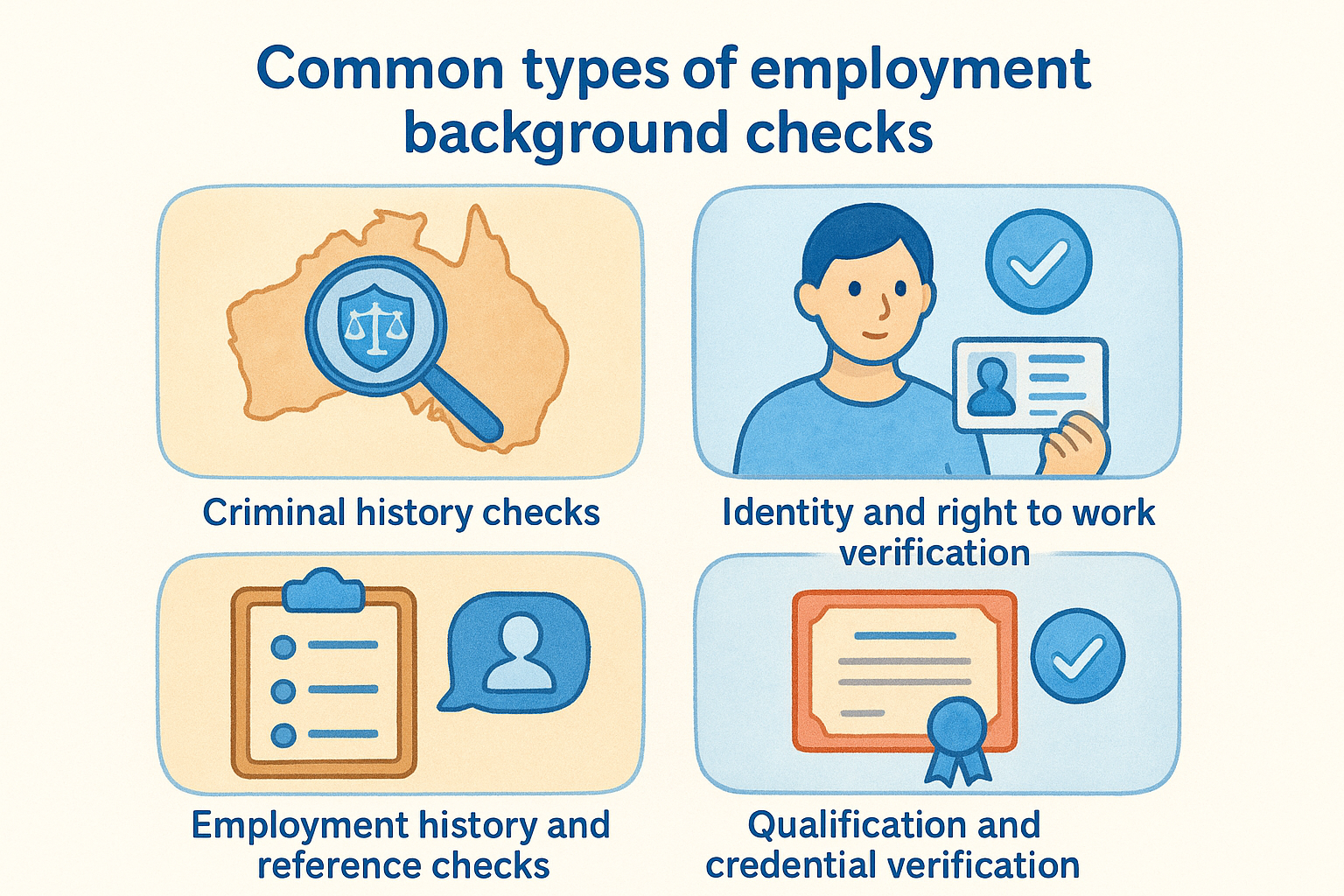
Criminal history checks
A criminal history check searches national police records held by the Australian Federal Police or relevant state agencies to identify any recorded offences. For roles involving vulnerable populations, financial authority, or positions of trust, this check is often mandatory rather than optional. Keep in mind that spent convictions legislation limits what you can legally act on, so you need to interpret results carefully and within the bounds of anti-discrimination law.
A criminal history check only tells you what’s on record; combining it with thorough reference checks gives you a more complete picture of a candidate’s suitability.
Identity and right to work verification
Identity verification confirms that the person you’re hiring is who they claim to be. Right to work checks confirm that they hold the legal entitlement to work in Australia under the Migration Act 1958. Both checks are foundational, and the right to work check carries a direct legal obligation for all Australian employers regardless of industry.
Employment history and reference checks
These checks confirm where a candidate has worked previously, the roles they held, their tenure, and the circumstances under which they left. Contacting previous employers directly rather than relying solely on candidate-supplied references gives you more reliable and objective information. Discrepancies between a candidate’s stated employment history and what references confirm are worth investigating before you proceed.
Qualification and credential verification
Credential verification confirms that the qualifications, licences, and certifications a candidate lists on their application are genuine and current. This is particularly relevant in regulated professions such as accounting, law, nursing, and financial services, where holding a valid licence is a legal prerequisite for performing certain tasks. Verifying credentials directly with the issuing institution or the relevant professional body is the most reliable approach.
Which checks to use for different roles
Not every position carries the same risk profile, so applying a one-size-fits-all approach to screening is both inefficient and potentially non-compliant. Matching the types of background checks for employment to the specific responsibilities of each role keeps your process proportionate, legally defensible, and cost-effective.
Roles involving vulnerable people or financial authority
Some positions require the most thorough screening by law or by professional obligation. These include roles in aged care, childcare, and disability services, as well as any position where the person will manage funds, authorise payments, or hold signing authority over client accounts.
For these positions, run a criminal history check, identity verification, and right to work confirmation as your baseline. Add a Working with Children Check where direct contact with minors applies, and verify any professional registrations the role requires. Where financial responsibility is involved, a credit history check can also help you assess how the candidate manages financial obligations.
The more sensitive the role, the broader your screening baseline needs to be, but each check still requires a documented rationale tied to the specific duties.
Professional and licensed roles
Accountants, lawyers, financial advisers, and other licensed professionals need credential verification as a non-negotiable step. Confirm that any licence or registration the candidate lists is current and valid with the relevant regulatory body, such as the Tax Practitioners Board, CPA Australia, or ASIC.
Employment history verification is also worth running for these roles. Discrepancies in work history are more common in professional services than most employers expect, and catching them before onboarding saves significant time and potential liability down the track.
General and administrative roles
Roles with no financial authority, no access to vulnerable populations, and no licensing requirements typically suit a lighter screening package. Identity verification and right to work checks remain mandatory for every hire, regardless of seniority or role type.
Adding a reference check and employment history confirmation gives you a reliable picture of how the candidate has performed elsewhere and whether their stated experience holds up. That combination covers the core bases without overreaching into checks that aren’t proportionate to the position.
How to run background checks step by step
Running a structured process means you stay compliant, consistent, and efficient across every hire. Before you start, map out which types of background checks for employment apply to the role you’re filling. This avoids collecting information you have no legitimate reason to hold and keeps your process proportionate from the start.
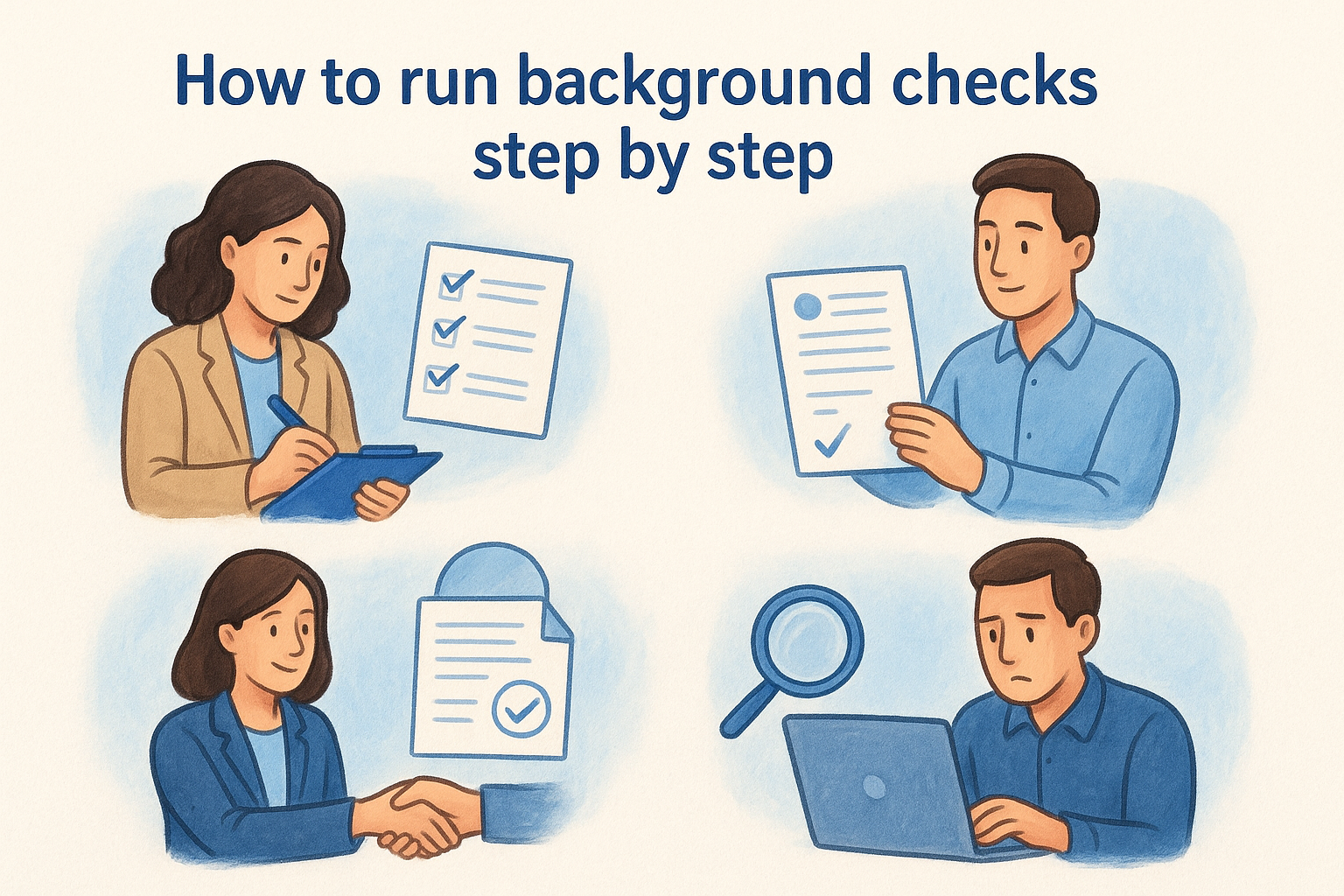
Define the check requirements for each role
Start by listing the specific duties and responsibilities of the position. From that list, identify which checks are legally required and which are proportionate to the risk profile. Document your reasoning for each check type before you begin screening any candidate. This documentation becomes your evidence of a deliberate and defensible process if your hiring decisions are ever questioned.
Building a role-based screening matrix gives you a repeatable template you can apply consistently across similar positions, which saves significant time as you scale.
Obtain written consent from the candidate
Send the candidate a clear, dedicated consent form that names each check you intend to run and explains why you’re running it. Avoid bundling consent into your general employment agreement. Keep a signed copy of the consent form in the candidate’s file so you have a documented record on hand if you ever need to demonstrate compliance with the Australian Privacy Act.
Engage a reputable screening provider
Select a provider that covers the specific checks your roles require and operates within the Australian Privacy Act framework. Confirm that they draw from verified data sources, such as the Australian Federal Police for criminal history checks, and that their reporting returns clear, structured results rather than raw data you then need to interpret yourself.
Review results and make your decision
Once results come back, compare them against the documented requirements you set for the role. Flag any discrepancies between what the candidate stated and what the checks confirm, and give the candidate an opportunity to respond before you reach a final decision. Base your outcome on the direct relevance of any finding to the specific duties of the role, not on a general reaction to the result. This keeps your process fair and defensible under Australian anti-discrimination law.
How to handle results, privacy, and records
Once your screening results arrive, how you handle them matters as much as running the checks in the first place. The Australian Privacy Act 1988 imposes ongoing obligations that extend well beyond the initial consent stage, covering how you store, access, and eventually destroy the personal information you’ve collected through the types of background checks for employment you’ve run.
Notify candidates and give them a fair hearing
Before you act on a result that works against a candidate, give them the opportunity to respond. This is both a fairness obligation and a practical safeguard. Screening data can contain errors, outdated information, or entries that the candidate can provide context for. Acting without giving the candidate a chance to respond exposes you to discrimination complaints and weakens your position if your decision is later challenged.
Documenting every step of your decision-making process, including candidate responses and your reasoning, is the clearest way to demonstrate that your process was fair and proportionate.
After reaching a decision, notify the candidate of the outcome in writing and confirm which check or checks informed your reasoning. You are not required to share the raw report with the candidate, but you should confirm that screening informed your decision and provide enough detail for them to understand what finding was relevant.
Store and destroy records securely
Personal information collected during screening must be stored securely and accessible only to those with a legitimate reason to view it. Under the Australian Privacy Principles, you are required to protect sensitive data, including criminal history and health information, from unauthorised access, misuse, or disclosure. Access controls, multi-factor authentication, and audit logging are practical measures that help you meet this obligation.
Set a defined retention period for screening records based on your legal obligations and the nature of the role. Once that period expires, destroy the records securely rather than simply deleting files. For digital records, this means using deletion methods that prevent recovery. Retaining data longer than necessary is itself a breach of the Australian Privacy Principles, so building a clear disposal schedule into your process protects you from that risk.
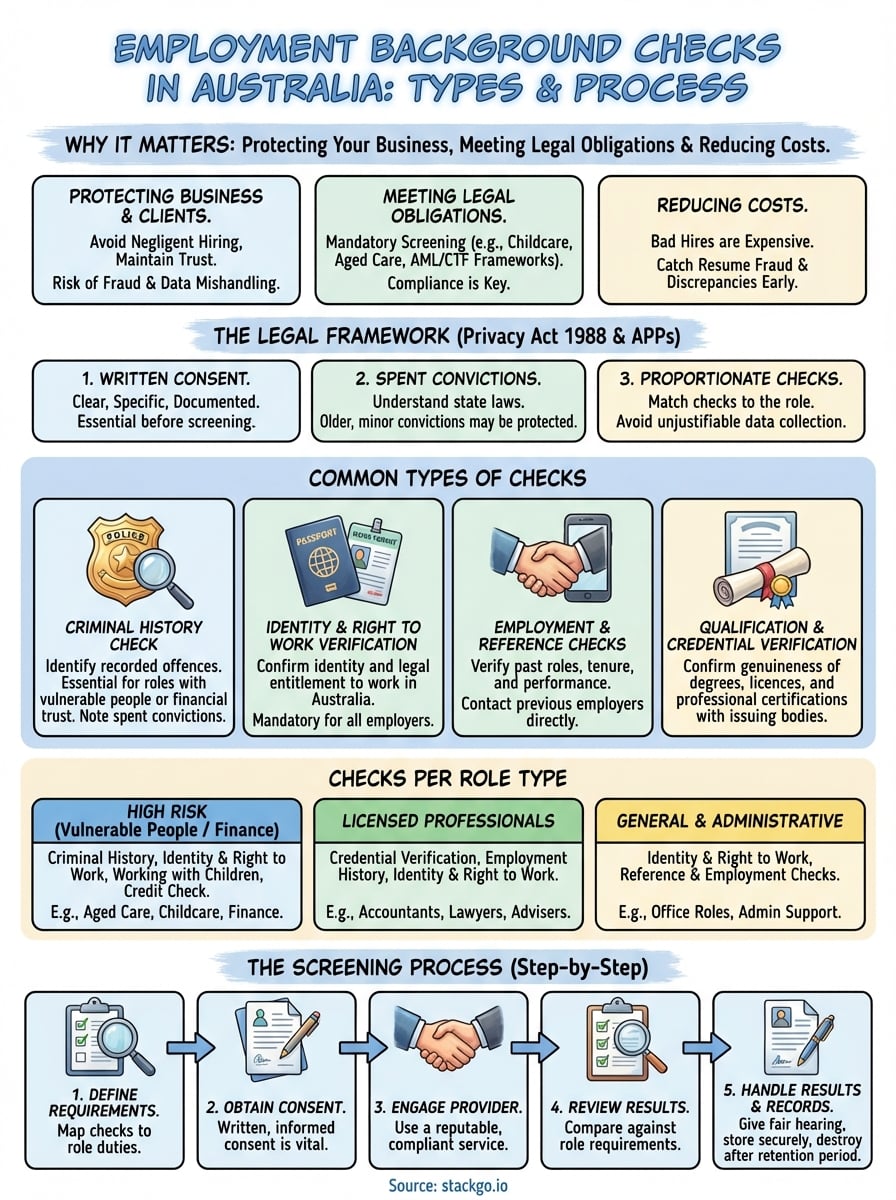
Next steps
Running the right types of background checks for employment protects your business, keeps you compliant with Australian law, and gives you a solid basis for every hiring decision you make. You now have a clear picture of which checks apply to different roles, what the legal framework requires, and how to handle results and records responsibly. The remaining step is building a screening process that actually runs efficiently, without creating bottlenecks or relying on manual workflows that slow your team down.
StackGo’s IdentityCheck lets you verify candidates and clients directly inside your existing CRM, so your team runs checks without switching tools or managing disconnected systems. If your firm falls under AUSTRAC’s upcoming Tranche 2 obligations, this matters even more. You can explore how IdentityCheck handles AUSTRAC AML/CTF compliance inside your current software stack, or create a free account to see whether it suits your business.


