

Tranche 2 is no longer a hypothetical. With AUSTRAC’s AML/CTF regime extending to accountants, the question has shifted from "will this affect us?" to "what’s this going to cost?" Understanding accountant AML compliance cost is now a practical necessity, and the range of prices out there is wide enough to cause decision paralysis.
The real challenge isn’t just picking a number. It’s comparing fundamentally different approaches: hiring a consultant, buying standalone software, building something in-house, or using an integrated solution that fits your existing tech stack. Each option carries different upfront costs, ongoing fees, and hidden time sinks that don’t always show up on the quote.
At StackGo, we build integration tools like IdentityCheck that let accounting firms run KYC/AML verification directly from their CRM, no new platforms to learn, no tab-switching, no manual data entry. So we’ve seen firsthand how compliance costs stack up across different setups.
This article breaks down four common approaches to AML compliance for Australian accounting firms, with real cost comparisons so you can make a clear-eyed decision before Tranche 2 hits your practice.
1. StackGo IdentityCheck integration into your stack
StackGo IdentityCheck sits inside your existing CRM, such as HubSpot or Salesforce, and runs KYC/AML identity verification directly from a contact record. You don’t log into a separate platform, copy-paste client data, or manage another dashboard. The verification result writes back automatically, so your team works from one place without any manual reconciliation.

What you pay for and what you still need
IdentityCheck uses per-check pricing, meaning you pay for what you use rather than a fixed annual licence. A single verification covers identity document checks, watchlist screening, and PEP/sanctions checks in one workflow. You still need to document your AML/CTF programme, train staff on their obligations, and appoint a compliance officer, but IdentityCheck handles the operational verification layer for you.
Cost drivers for accounting firms
The main variable in your accountant AML compliance cost is check volume. A firm onboarding 50 new clients per month spends considerably less than one processing 500. Because pricing scales with usage, you avoid paying a flat annual fee regardless of activity. Set-up costs are low because IdentityCheck connects to your CRM without custom development, removing the implementation fees that inflate other approaches.
Firms already using HubSpot or Salesforce can typically activate IdentityCheck and run their first verified check on the same day.
Where this approach saves money and time
The biggest saving is staff time. Manual identity checks across separate portals can take 15 to 30 minutes per client when you factor in data entry, document uploads, and result logging. IdentityCheck reduces that to under two minutes per check, which means a firm with 100 new clients a month can recover 25 to 50 hours every month for billable work.
Your privacy layer also removes the liability of storing PII inside your CRM, cutting down data governance overhead without requiring another standalone compliance tool.
Best-fit scenarios and red flags
IdentityCheck suits firms that already run a supported CRM and want compliance embedded into their onboarding workflow rather than managed separately. It works well for practices of any size that prioritise speed, accuracy, and minimal disruption to existing processes.
The approach is less suited to firms that have no CRM foundation at all or prefer a fully standalone portal with built-in case management. If your practice still operates primarily on spreadsheets and email, that infrastructure gap needs addressing before any integration makes sense.
2. Dedicated AML compliance software platform
Standalone AML compliance platforms are purpose-built tools that handle identity verification, watchlist screening, and case management from a separate dashboard outside your existing software. Providers like these typically sell annual licences with tiered pricing based on user seats or verification volume, and they often include built-in audit trails and reporting features designed specifically for regulated industries.
What you pay for and what you still need
You pay for access to the platform, onboarding, and ongoing licences, which commonly range from $3,000 to $15,000 per year depending on firm size and features. You still need to manually transfer client data between your CRM and the compliance platform, train staff on a new interface, and maintain your own documented AML/CTF programme separately from the tool.
Cost drivers for accounting firms
The accountant AML compliance cost here is driven primarily by seat-based or volume-based licence tiers, meaning a growing firm can hit the next pricing bracket quickly. Implementation and onboarding fees add another layer, and some providers charge separately for premium watchlist databases or enhanced due diligence checks.
Switching costs are also real: once your case history lives inside a standalone platform, migrating away from it later becomes an expensive and time-consuming project.
Where this approach saves money and time
Standalone platforms often include pre-built compliance workflows and audit reporting, which reduces the time your compliance officer spends on documentation. If you operate without a CRM or have no integration infrastructure, this approach removes the need to build one before getting started.
Best-fit scenarios and red flags
This option suits firms that prefer an all-in-one compliance portal and have staff capacity to manage a separate tool. It becomes a red flag when your team is already stretched thin, because context-switching between platforms adds friction and increases the risk of data entry errors during client onboarding.
3. AML consultant or legal-led build
Hiring an AML consultant or compliance lawyer to build your programme from scratch is the most hands-off approach available. A specialist comes in, assesses your firm’s risk profile, drafts your AML/CTF programme, and often delivers staff training and ongoing advisory support as part of the engagement.
What you pay for and what you still need
You pay for professional time, which typically ranges from $5,000 to $25,000 for an initial build depending on firm complexity. That fee covers document drafting, risk assessment, and implementation guidance. You still need to run identity verifications operationally after the consultant leaves, which means sourcing a separate tool or reverting to manual checks regardless of how well your programme is documented.
Cost drivers for accounting firms
The main driver behind this accountant AML compliance cost is scope. A simple engagement for a small practice costs far less than a full build for a multi-partner firm with diverse client types. Ongoing retainer fees for advisory support and annual programme reviews add significantly to the total, and these are often necessary because AUSTRAC regulations require your programme to stay current as your business changes.
Consultant fees can escalate quickly when regulatory updates require programme revisions, turning a one-time cost into a recurring line item.
Where this approach saves money and time
A well-structured programme built by an expert reduces your risk of regulatory penalties, which can far exceed the consulting fee itself. It also removes the burden of interpreting complex legislation from your internal team, which is a genuine time saving for practices without a dedicated compliance function.
Best-fit scenarios and red flags
This option suits firms with complex risk profiles or multi-jurisdictional clients that genuinely need specialist input. It becomes a red flag when the consultant delivers documentation without any operational verification tool attached, leaving your team to handle day-to-day checks manually with no workflow efficiency gained.
4. DIY with AUSTRAC templates plus manual checks
AUSTRAC provides free guidance and template documentation to help regulated entities build their AML/CTF programme. Some smaller accounting firms choose to download these materials, adapt them internally, and run identity checks manually using free or low-cost document verification methods. On paper, this approach carries the lowest upfront cost of any option.
What you pay for and what you still need
Your primary cost here is staff time. Building a compliant programme from templates requires someone in your firm to read, interpret, and accurately adapt AUSTRAC’s guidance to your specific client types and risk profile. You also still need a practical verification method, which typically means:
- Requesting physical identity documents from clients
- Cross-checking them manually against government-issued records
- Logging outcomes in a spreadsheet or document file
Cost drivers for accounting firms
The hidden driver behind this accountant AML compliance cost is the volume of untracked internal labour hours. A practice manager spending 40 hours building the programme and several hours each month maintaining it absorbs real cost, even when no invoice exists.
Those internal hours are also opportunity cost: time your practice manager spends on compliance documentation is time not spent on client work or firm growth.
Where this approach saves money and time
This approach avoids software licence fees entirely and keeps your cash outlay near zero at the start. For very small firms with a stable, low-volume client base, the manual effort may be workable in the short term before full Tranche 2 enforcement begins.
Best-fit scenarios and red flags
DIY suits a sole practitioner with a low-risk client base and genuine capacity to engage with the requirements properly. The red flag appears the moment your onboarding volume increases, because manual checks do not scale and your error rate rises with your workload.
What to do next
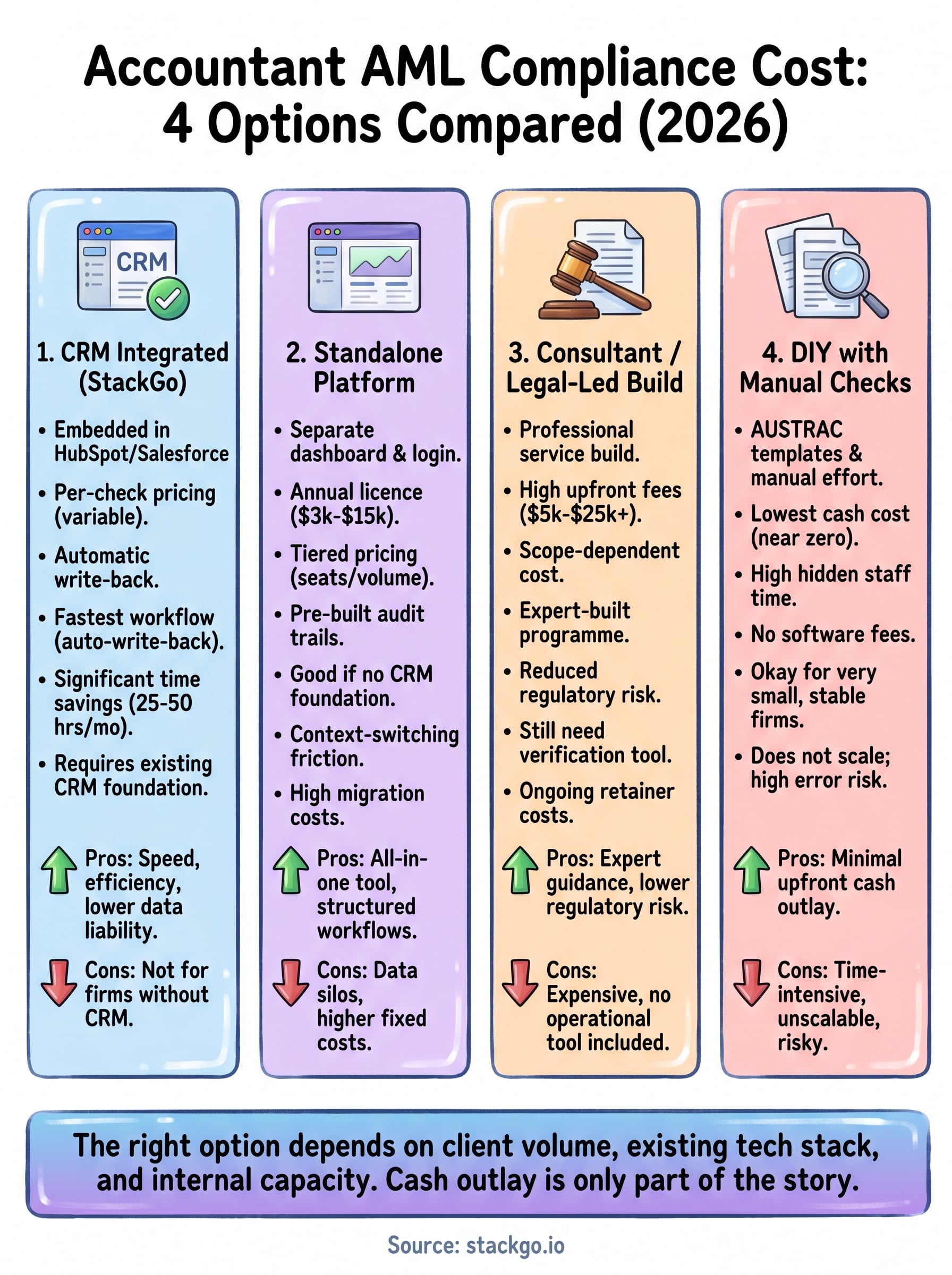
Every accounting firm lands somewhere different on the cost-versus-effort spectrum, and the right option depends on your client volume, your existing tech stack, and how much internal capacity you have for compliance administration. The accountant AML compliance cost across these four approaches ranges from near zero in cash terms (DIY) to $25,000+ (consultant-led build), but cash outlay alone does not tell the full story once you factor in staff time and operational risk.
If your firm already runs HubSpot or Salesforce, the fastest way to test whether an integrated approach works for you is to run a real verification yourself. StackGo IdentityCheck connects to your CRM without custom development, and you can see the workflow in under a day.
Start with a free account and run your first check before committing to anything: try IdentityCheck for your accounting firm. You can also read more about how it handles AUSTRAC Tranche 2 requirements.


