

If your business deals in high-value goods, precious metals, jewellery, motor vehicles, or art, you’re likely already aware that AUSTRAC high value dealer obligations apply to you. But with the AML/CTF regime expanding under Tranche 2 reforms, the compliance bar is shifting, and what worked yesterday may not cut it tomorrow.
High value dealers (HVDs) must register with AUSTRAC, verify customer identities, monitor transactions, and submit suspicious matter reports. These aren’t optional boxes to tick, they carry real penalties for non-compliance, including civil and criminal liability. Whether you’re newly caught by the expanded definitions or you’ve been registered for years, staying across your obligations is critical as regulatory expectations tighten through 2026 and beyond.
This guide breaks down exactly what AUSTRAC expects from high value dealers right now: registration, customer due diligence, reporting, and record-keeping. We’ll also cover where the reforms are headed and how tools like StackGo’s IdentityCheck can help you run KYC/AML verification directly from your existing software, removing the compliance headaches that come with manual processes and disconnected systems.
Why AUSTRAC regulates high value dealers
High-value goods are an attractive vehicle for money laundering. Cash transactions involving luxury items like jewellery, gold, or prestige vehicles can move large sums quickly, without leaving the paper trail that banks and financial institutions create automatically. AUSTRAC targets this sector because criminals exploit gaps in oversight to integrate illicit money into legitimate trade.
High-value goods sectors have historically been used to place, layer, and integrate dirty funds with minimal scrutiny, making dealer-level oversight a critical control point.
The link between cash, crime, and goods
Australia’s AML/CTF Act places high value dealers within the regulated reporting entity category because a single cash transaction can shift hundreds of thousands of dollars in value. Criminal networks use over-invoicing, under-invoicing, and structured purchases to obscure the origin of funds. Without regulation, these transactions pass through the economy largely undetected.
The AUSTRAC high value dealer obligations framework exists specifically to create accountability at the point of sale. When you collect and verify customer information, you generate records that investigators can use to trace illicit financial flows. That verification step is not a formality; it is a genuine disruption to the money laundering process.
Why cash thresholds matter
The current trigger for reporting obligations is a cash transaction of AUD 10,000 or more. AUSTRAC sets this threshold because it captures transactions large enough to be meaningful in a laundering context while keeping compliance manageable for everyday retail operations. Transactions just below this threshold can also trigger obligations if you suspect structuring, where a buyer deliberately splits a purchase to avoid crossing the threshold.
Understanding why the threshold exists helps you apply it correctly in practice. Misapplying or ignoring it is precisely where businesses attract regulatory scrutiny and enforcement action.
Who counts as a high value dealer in 2026
Under the Anti-Money Laundering and Counter-Terrorism Financing Act 2006, a high value dealer is any business or sole trader that accepts cash payments of AUD 10,000 or more for goods. The definition is straightforward, but the range of businesses it captures is wider than many operators realise.
The core definition under the AML/CTF Act
AUSTRAC defines a high value dealer based on the payment method and the transaction amount, not the type of goods sold. If your business accepts a single cash payment of AUD 10,000 or more, or foreign currency equivalent, you fall within scope. Part of your AUSTRAC high value dealer obligations is recognising that this applies even if cash transactions are rare for your business.
A single qualifying cash transaction is enough to trigger your registration and compliance obligations, regardless of how infrequently it happens.
Which sectors are typically caught
The following business types most commonly meet the definition:
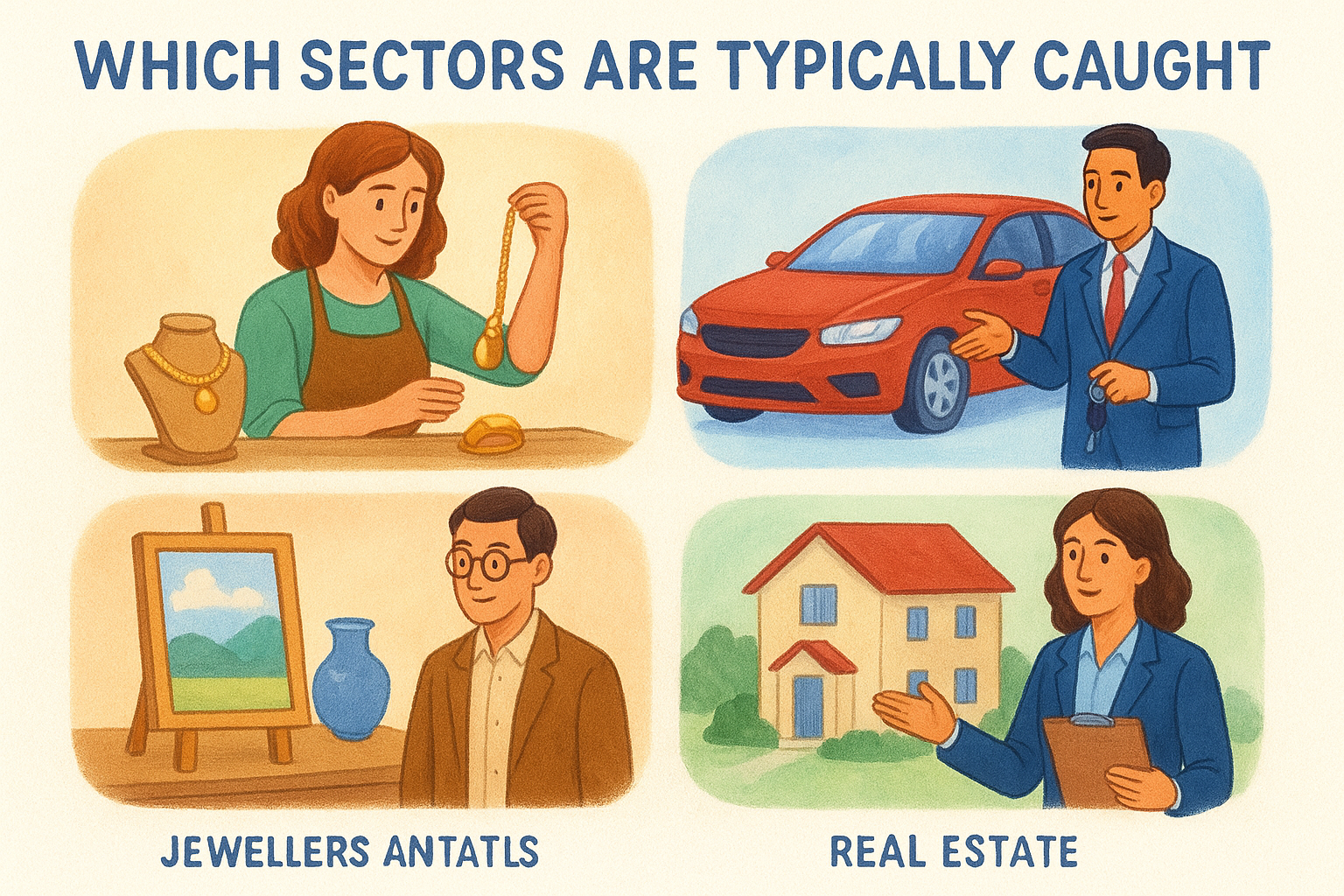
- Jewellers and precious metal dealers, including gold buyers and coin traders
- Motor vehicle dealers, covering cars, motorcycles, and boats
- Art and antique dealers accepting large cash payments
- Real estate agents in specific transaction contexts
Your business type determines which customer due diligence and reporting requirements apply in practice, so confirming your category with AUSTRAC is an important first step.
What AUSTRAC obligations apply to high value dealers
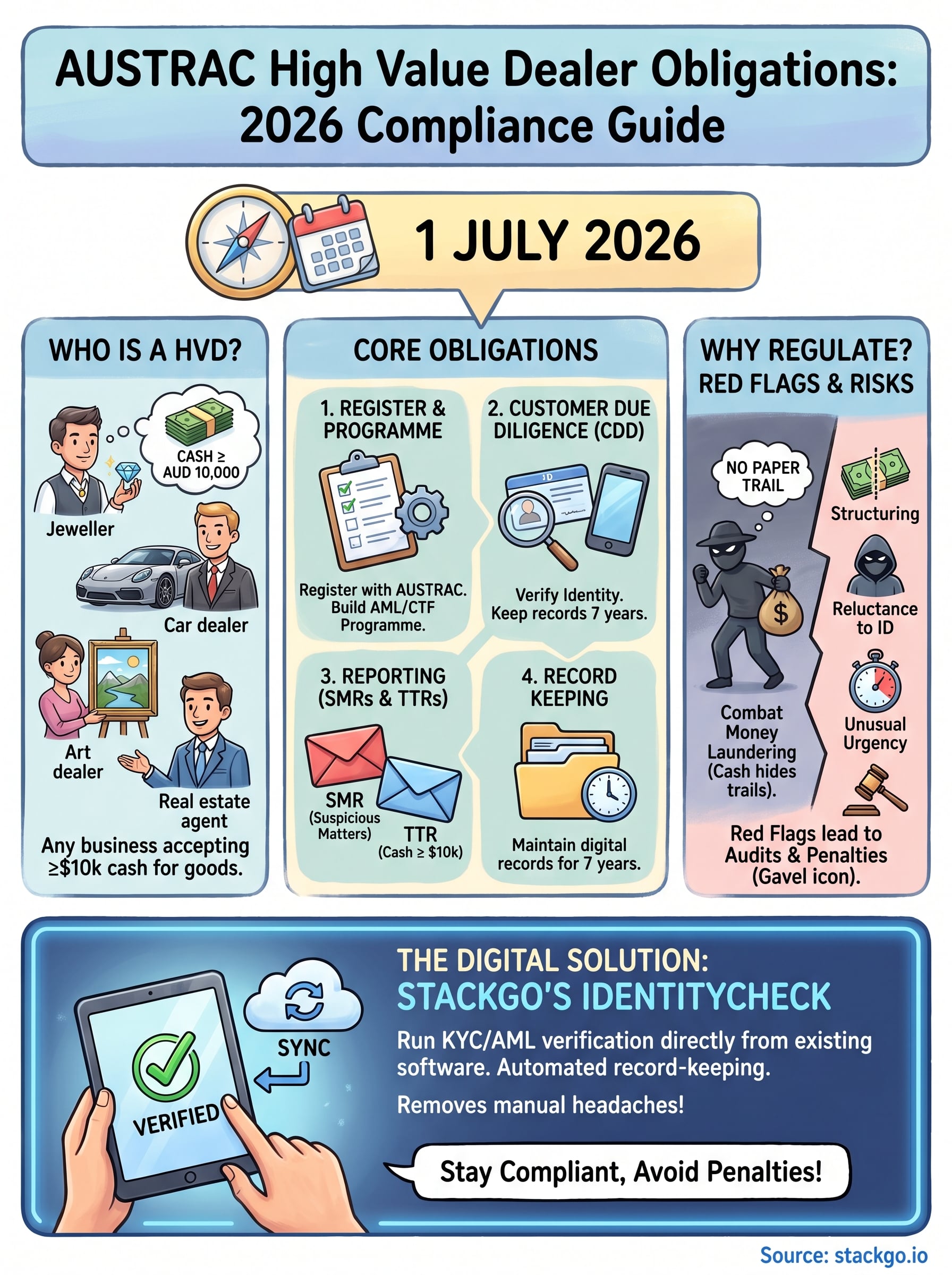
Once you meet the definition, your AUSTRAC high value dealer obligations cover four core areas: registration, maintaining an AML/CTF programme, conducting customer due diligence, and submitting reports. Each area carries specific requirements, and failing any one of them can expose your business to regulatory action from AUSTRAC.
Registration and your AML/CTF programme
You must register with AUSTRAC before providing designated services that involve qualifying cash transactions. After registration, you need to develop and maintain an AML/CTF programme that identifies the money laundering and terrorism financing risks your business faces and outlines the controls you have in place to manage them. AUSTRAC expects you to review and update this programme regularly, not treat it as a one-time document.
A programme that sits unreviewed is unlikely to satisfy AUSTRAC if they conduct an audit of your business.
Customer due diligence and reporting
Customer due diligence (CDD) requires you to verify the identity of customers involved in qualifying transactions before completing the sale. You must also keep records of your verification steps for at least seven years so that AUSTRAC can access them during an investigation.
Your reporting obligations include:
- Suspicious matter reports (SMRs): Submit when any transaction raises red flags, regardless of the amount
- Threshold transaction reports (TTRs): Required for all cash transactions of AUD 10,000 or more
How to comply step by step before 1 July 2026
With 1 July 2026 as the key deadline, acting now gives you time to build compliance into your operations properly. Meeting your AUSTRAC high value dealer obligations requires a clear sequence of steps, not a last-minute scramble.
Register and build your AML/CTF programme first
Registration with AUSTRAC is the first non-negotiable step. Complete this through the AUSTRAC Online portal before you accept any qualifying cash transaction. Once registered, develop your AML/CTF programme by documenting your risk assessment, your controls, and the processes your staff will follow for customer due diligence.
Treat your programme as a living document that you update when your business changes. AUSTRAC expects you to review it regularly, and an outdated programme is unlikely to satisfy an auditor.
Set up your verification and reporting processes
Assign clear responsibility for submitting threshold transaction reports and suspicious matter reports before transactions occur. Your customer due diligence process needs to be operational and tested, not assembled under pressure when a qualifying transaction arrives.

Registering without operational verification and reporting processes in place leaves your business exposed during any AUSTRAC compliance check.
Train your staff so they understand what triggers a report and confirm your record-keeping meets the seven-year retention requirement from day one.
Red flags, audits, and staying compliant long term
Staying compliant means more than completing registration and filing reports. Your AUSTRAC high value dealer obligations require you to actively monitor transactions and recognise suspicious behaviour before it escalates into a regulatory problem. AUSTRAC can audit your business at any time, and businesses that lack documented processes face significant penalties.
Recognising red flags before they become problems
Certain transaction patterns consistently attract AUSTRAC scrutiny. Treat the following as triggers for a suspicious matter report, regardless of whether the transaction reaches the AUD 10,000 cash threshold:
- A customer insisting on cash payment without a clear explanation
- Structured purchases split across multiple transactions to avoid the threshold
- A customer reluctant to provide identity documents or offering inconsistent information
- Unusual urgency to complete a high-value transaction
If something about a transaction feels wrong, your obligation to report applies immediately, not after you complete the sale.
Preparing for an AUSTRAC audit
AUSTRAC auditors look for documented evidence of your processes, not just written policies. Retain seven years of verification records and keep your AML/CTF programme updated to reflect any changes to your business operations.
Schedule a formal internal review every 12 months. Documenting each review outcome gives you a clear compliance history that demonstrates active management rather than a reactive response if AUSTRAC examines your business.
Next steps
Your AUSTRAC high value dealer obligations cover registration, customer due diligence, reporting, and record-keeping, and the 1 July 2026 deadline does not leave much room for delay. If you have not registered with AUSTRAC yet, that is the first task to complete this week. Follow registration by documenting your AML/CTF programme, setting up your verification process, and training staff on what triggers a suspicious matter report.
Running identity verification manually adds friction to every qualifying transaction and creates gaps in your records. StackGo’s IdentityCheck lets you verify customer identities directly inside your existing software, whether that is HubSpot, Salesforce, or another platform you already use daily. Your compliance records write back automatically, so you always have the documentation AUSTRAC expects to see. Find out how it works for your specific setup by reading about AUSTRAC Tranche 2 AML/CTF compliance with IdentityCheck, or create a free account to test it today.


