

If you work in compliance, fraud prevention, or financial crime risk management, you’ve likely come across the ACAMS AML certification, formally known as the Certified Anti-Money Laundering Specialist (CAMS) credential. It’s widely regarded as the gold standard qualification for AML professionals, recognised by employers and regulators across the globe, including here in Australia.
But deciding whether to pursue it raises practical questions. How much does it cost? What are the eligibility requirements? How hard is the exam, and what does it actually do for your career? These are the details that matter before you commit your time and money, and this article covers all of them in one place.
At StackGo, we build integration tools, like IdentityCheck, that help regulated businesses run KYC and AML verification directly from their existing software stack. We work closely with compliance teams across accounting, financial services, and professional services in Australia, so we understand the regulatory environment these certifications sit within. Whether you’re strengthening your own credentials or upskilling your team ahead of upcoming AUSTRAC AML/CTF obligations, this guide will help you make an informed decision about CAMS certification.
What ACAMS is and what CAMS covers
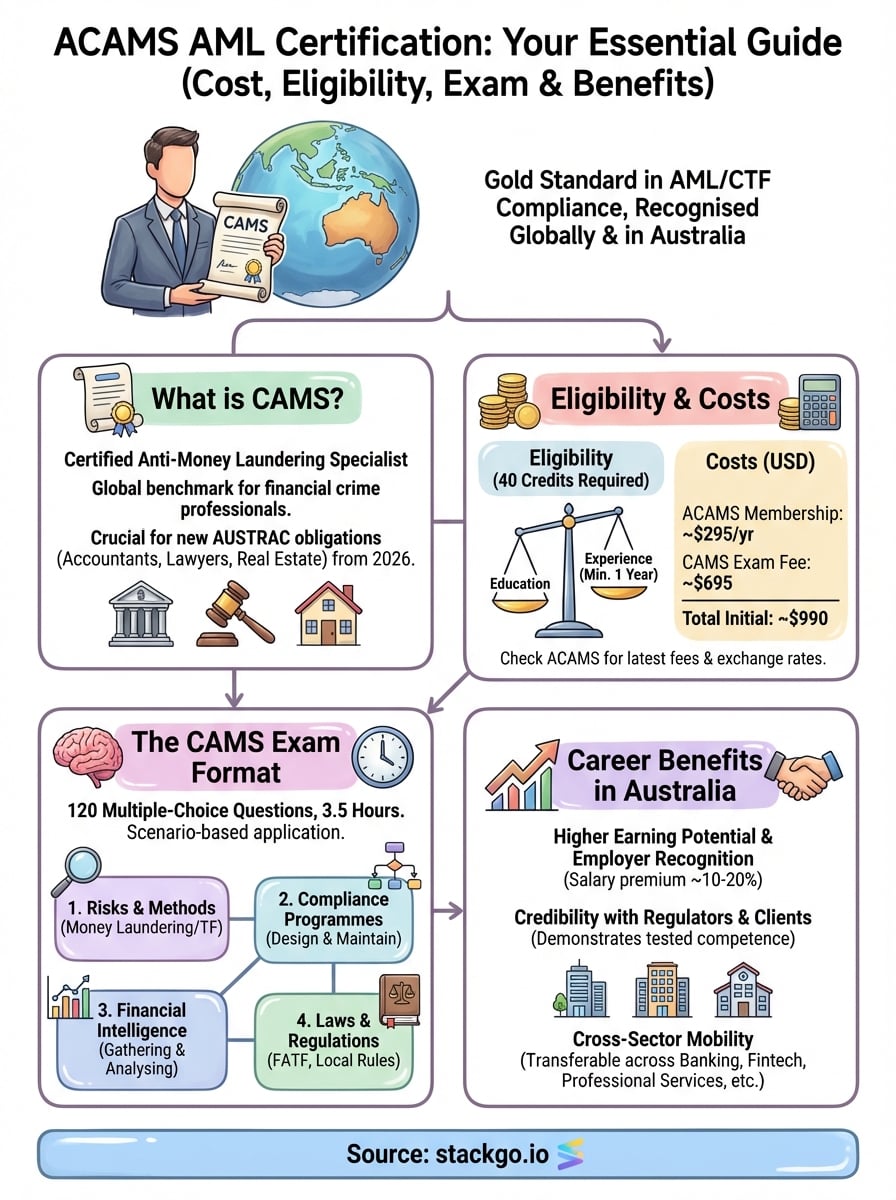
ACAMS stands for the Association of Certified Anti-Money Laundering Specialists. It is a global non-profit membership organisation dedicated to training and certifying financial crime compliance professionals across more than 180 countries. Founded in 2001 and headquartered in Miami, ACAMS has grown into the largest international body focused exclusively on the prevention of money laundering and financial crime. Its flagship qualification is the Certified Anti-Money Laundering Specialist (CAMS), and when compliance professionals in Australia or anywhere else refer to the ACAMS AML certification, this is the credential they mean.
The organisation behind the credential
ACAMS operates as a membership organisation, which means you join as a member before you pursue the certification. Membership gives you access to training resources, industry events, and a professional network of compliance specialists across banking, financial services, legal, accounting, and other regulated sectors. Beyond credentialing, ACAMS produces research on emerging financial crime threats, maintains regional chapters in cities worldwide, and publishes guidance on evolving global AML standards. These activities are a large part of why the CAMS credential carries genuine weight with employers and regulators who want assurance that their compliance teams understand international best practice, not just local rules.
In Australia, the ACAMS community continues to expand. Upcoming regulatory changes under the Anti-Money Laundering and Counter-Terrorism Financing Amendment Act 2024 are bringing a much wider range of businesses, including accounting firms, lawyers, and real estate agents, into the AML/CTF regime from 2026 onward. That expansion is increasing demand for credentialed compliance professionals and making the CAMS qualification more relevant to Australian practitioners than it has ever been.
ACAMS is not a government regulator, but its CAMS credential is widely recognised by regulators, including AUSTRAC, as a reliable benchmark of professional competence in AML compliance.
What the CAMS exam actually covers
The CAMS certification tests your knowledge across four core domains, each grounded in the real-world responsibilities of a working AML compliance professional. Understanding these domains before you start studying matters because the curriculum is broad and the exam expects you to apply knowledge, not simply recall definitions.
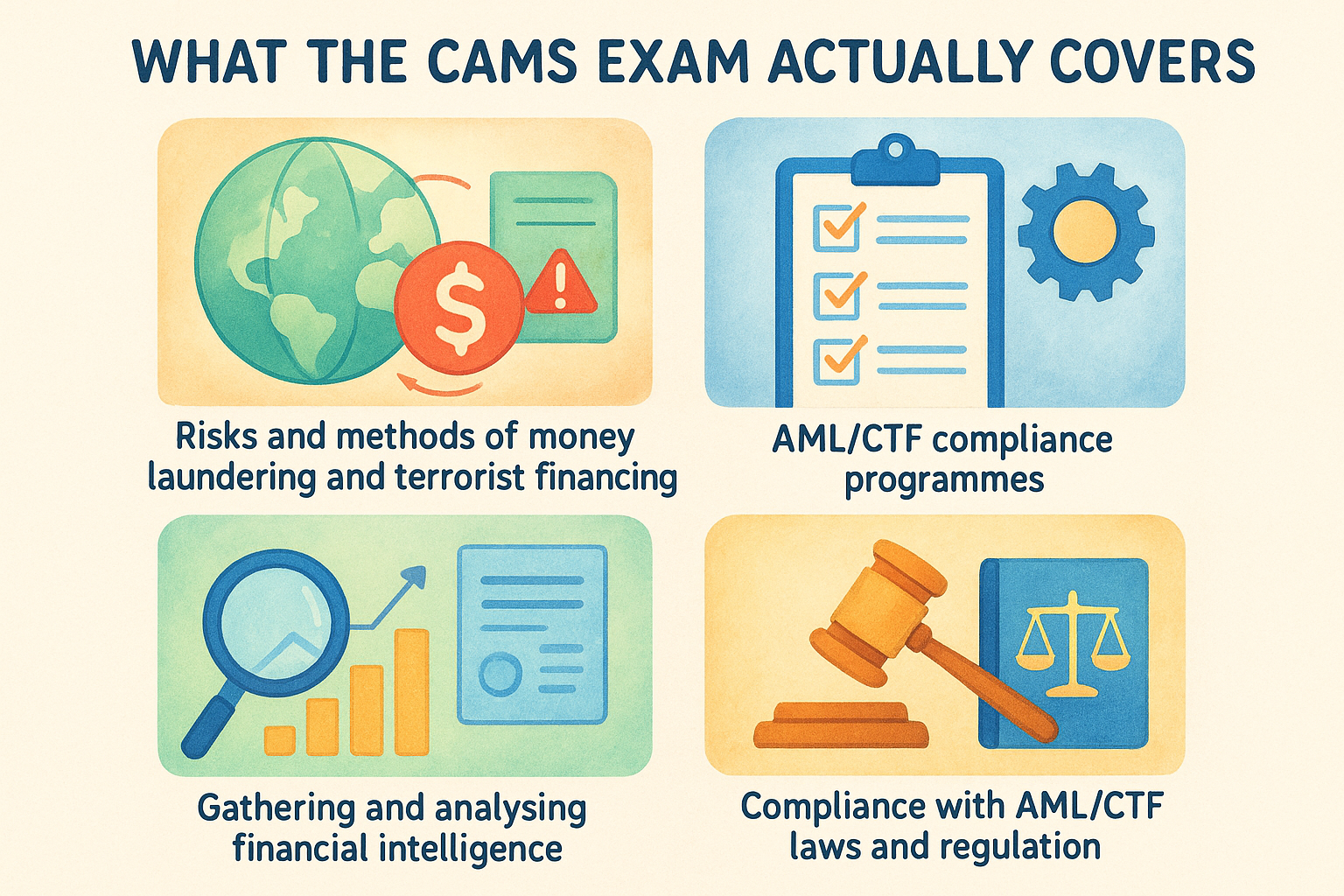
The four domains are:
- Risks and methods of money laundering and terrorist financing – how illicit funds move, the typologies used across different sectors, and the red flags that indicate suspicious activity
- AML/CTF compliance programmes – how regulated entities design, implement, and maintain effective internal compliance frameworks
- Gathering and analysing financial intelligence – using data, reporting mechanisms, and investigation techniques to identify and escalate suspicious behaviour
- Compliance with AML/CTF laws and regulation – applying legal requirements across jurisdictions, including Financial Action Task Force (FATF) recommendations and local legislative obligations
Each domain carries a different weighting in the exam, and ACAMS publishes the full breakdown in its official study guide so you can prioritise your preparation accordingly. The curriculum is updated regularly to reflect changes in global standards and emerging threats, including virtual asset risks, beneficial ownership transparency, and the use of technology in financial crime. For Australian practitioners, the content maps closely to the obligations affecting designated reporting entities under AUSTRAC’s framework, which makes CAMS study directly useful to the compliance work you will be doing in practice, not just useful for passing a test.
Why CAMS matters in 2026
The compliance landscape in Australia has changed significantly, and that change directly affects how much weight the acams aml certification carries right now. The Anti-Money Laundering and Counter-Terrorism Financing Amendment Act 2024 brings a large group of previously unregulated businesses, including accounting firms, lawyers, conveyancers, and commercial real estate agents, into Australia’s AML/CTF regime from 1 July 2026. That means tens of thousands of businesses are building compliance programmes from scratch, and the demand for professionals who understand what those programmes require has never been higher.
Australia’s expanding AML/CTF obligations
AUSTRAC now expects a much broader range of entities to register, conduct customer due diligence, implement AML/CTF programmes, and report suspicious matters. These are not light obligations. Businesses that get them wrong face civil and criminal penalties, reputational damage, and the risk of regulatory action. For professionals working in or alongside these sectors, having a credential that demonstrates genuine AML competence is no longer a nice-to-have. It signals to your employer, your clients, and your regulator that you have the technical knowledge to design and run a compliant programme.
The FATF Mutual Evaluation of Australia, published in 2015, identified significant gaps in Australia’s AML/CTF framework. The 2024 amendments are a direct response, and AUSTRAC is actively monitoring implementation.
The timing also matters for career positioning. Businesses rushing to meet the 2026 compliance deadlines are hiring now. Practice managers at accounting firms, compliance leads at financial services companies, and operations staff at legal practices are all being asked to step into AML roles with little prior experience. If you already hold CAMS, or you earn it before these obligations take effect, you are competing for those roles from a significantly stronger position than candidates without a recognised credential.
What the global standard adds locally
CAMS is built on FATF recommendations, which underpin AML/CTF regimes in over 200 jurisdictions, including Australia’s. That means the knowledge you gain through the certification maps directly onto how AUSTRAC’s framework was designed. You are not learning abstract theory. You are learning the internationally agreed principles that shape every rule your clients or employer must follow, which makes your expertise practical and immediately applicable to real compliance work.
CAMS eligibility and ACAMS credits explained
Before you register for the exam, you need to meet ACAMS’s eligibility requirements. The system is credit-based, which means you accumulate points from a combination of your education and your professional experience. You must reach a minimum of 40 qualifying credits before ACAMS will approve your application to sit the CAMS exam. This threshold exists to ensure candidates have enough real-world grounding to apply the material the exam tests.
ACAMS membership is a prerequisite for sitting the CAMS exam. You must join as a member before your application is assessed, and membership fees are separate from exam fees.
How the ACAMS credit system works
Credits are allocated across two categories: education and work experience. Your level of formal education determines how many credits you receive from your academic background, and your years working in a relevant professional role contribute the remainder. The two categories together must reach 40 credits, and ACAMS requires you to hold a minimum of one year of work experience regardless of your educational qualifications.
The credit allocations for education are:
| Qualification | Credits awarded |
|---|---|
| High school diploma or equivalent | 0 |
| Associate degree or equivalent | 5 |
| Bachelor’s degree or equivalent | 10 |
| Postgraduate or master’s degree | 20 |
Each full year of qualifying work experience earns you one credit. If your educational background gives you 10 credits from a bachelor’s degree, you need a minimum of 30 years of relevant experience to meet the threshold through experience alone, which is why most candidates combine both categories.
What counts as qualifying experience
ACAMS defines qualifying work experience broadly, covering roles in compliance, audit, legal, law enforcement, financial intelligence, and related functions within regulated industries. You do not need to hold a title that includes the words "AML" or "compliance" to qualify. If your role involved customer due diligence, transaction monitoring, suspicious matter reporting, or regulatory oversight, it is likely to count.
For Australian practitioners, roles at AUSTRAC-regulated entities such as banks, credit unions, accountancy firms, and financial services businesses all qualify. If you are unsure whether your experience meets the criteria, ACAMS provides guidance on its website and its member support team can assess your specific background before you submit your application for the acams aml certification.
CAMS costs and what you get for the fee
The cost of pursuing the acams aml certification has two main components: ACAMS membership and the exam fee itself. You cannot sit the CAMS exam without being an ACAMS member, so both costs are unavoidable, and it pays to understand exactly what you are paying for before you budget for your study.
Membership and exam fees
ACAMS structures its pricing in tiers based on individual or corporate membership and your geographic region. For most Australian practitioners applying as individuals, the annual membership fee sits at approximately USD $295, while the exam fee adds a further USD $695 on top. That puts the total initial cost at roughly USD $990, or around AUD $1,500 to $1,600 depending on the exchange rate at the time you apply. If your employer sponsors your candidacy, some organisations cover both costs, so it is worth raising the question before you pay out of pocket.
ACAMS occasionally offers promotional pricing for new members or bulk corporate enrolments, so checking the ACAMS website directly before you register gives you the most accurate and current fee information.
| Fee component | Approximate cost (USD) |
|---|---|
| Individual ACAMS membership (annual) | USD $295 |
| CAMS exam fee | USD $695 |
| Total (first year) | USD $990 |
What the fee covers
Your membership fee is not just an entry ticket to the exam. It gives you access to the official CAMS study guide, which is the primary reference material most candidates use to prepare, along with access to ACAMS webinars, regional chapter events, and a global professional network of over 100,000 compliance specialists. These resources carry practical value well beyond the exam itself, particularly as your career develops and you need to stay current on emerging financial crime threats and regulatory changes.
The exam fee covers your one sitting of the CAMS exam, administered through a network of Pearson VUE testing centres, including locations across Australia. If you need to resit the exam, you pay an additional resit fee, which ACAMS publishes on its website. Keeping that cost in mind gives you a strong reason to approach your preparation seriously and give yourself the best possible chance of passing on your first attempt.
CAMS exam format and what it tests
Knowing how the exam is structured before you sit down to study changes how you prepare. The acams aml certification exam is not a simple recall test. It is designed to assess whether you can apply AML concepts to real compliance scenarios, which means your preparation needs to go beyond memorising definitions.
Number of questions and time allowed
The CAMS exam consists of 120 multiple-choice questions, and you have 3.5 hours to complete it. You sit the exam at a Pearson VUE testing centre, with locations available across Australia including in Sydney, Melbourne, Brisbane, and Perth. The exam is also available in an online proctored format if you prefer to sit from your own location. ACAMS sets a passing score using a scaled scoring method, and the current pass mark sits at 75% or higher, though ACAMS reserves the right to adjust this based on the difficulty of each exam version.
ACAMS uses a scaled scoring system, which means your raw score is adjusted to account for slight variations in difficulty between different exam versions, so all candidates are assessed against the same standard.
How the questions are written
Each question presents a scenario, a situation, or a direct knowledge check, and you select the best answer from four options. Many questions describe a realistic compliance situation, such as a customer presenting unusual transaction patterns or a business failing to update its AML programme, and ask you to identify the correct response or the most relevant risk indicator. This approach means you need a working understanding of how AML principles apply in practice, not just the ability to define terms from a glossary.
How the exam is weighted across domains
The 120 questions are not distributed evenly. ACAMS weights them according to four content domains, and understanding the split helps you direct your study time. The domain covering risks and methods of money laundering carries the largest share of questions, while the domains covering compliance programmes, financial intelligence, and regulatory frameworks account for the remainder. ACAMS publishes the exact weighting percentages in the official study guide, which you receive as part of your membership. Reviewing that breakdown early in your preparation helps you avoid spending equal time on unequal portions of the exam.
How to prepare and pass the CAMS exam
Preparing for the CAMS exam requires a structured approach rather than passive reading. Most candidates who pass on their first attempt allocate between 80 and 120 hours of study time across six to twelve weeks, working through the official ACAMS study guide methodically and testing their knowledge as they go. The goal is not just to read the material but to build the ability to apply it to the scenario-based questions the exam presents.
Start with the official study guide
The official ACAMS study guide is your primary resource and should anchor your entire preparation. It covers all four domains in depth, reflects the current exam weighting, and is updated to align with changes in global AML standards. Read each chapter actively by taking notes and summarising key concepts in your own words, which forces you to process the content rather than skim it.
After you work through the study guide, move to ACAMS practice exams, which you can access through the ACAMS member portal. These replicate the style and difficulty of real exam questions and are one of the most reliable indicators of whether you are ready to sit.
Candidates who complete at least two full practice exams before sitting the CAMS exam consistently report higher confidence and better results, according to feedback shared within ACAMS member communities.
Use study groups and chapter events
ACAMS regional chapters run study groups and preparation workshops in major Australian cities, and joining one adds a significant layer to your preparation. Discussing scenarios with peers who are also studying for the acams aml certification reinforces your understanding and exposes gaps you might not identify studying alone.
Chapter events also connect you with practitioners who have recently passed the exam and can share what they found most challenging. Their direct experience is more useful than generic advice, particularly for understanding which domains require the most intensive preparation.
Manage your exam day approach
On exam day, read every question carefully before selecting your answer. Many questions hinge on a specific word like "first" or "most likely," and missing that detail leads to errors on questions you actually understand. Work through the exam at a steady, deliberate pace, flagging questions you are uncertain about and returning to them once you have answered the rest.
After you pass: keeping CAMS active
Passing the CAMS exam is the start of your credential, not the end of it. The acams aml certification operates on a three-year renewal cycle, and you need to actively maintain it to keep the designation valid. ACAMS designed the renewal requirement to ensure CAMS holders stay current with developments in financial crime risk rather than coasting on knowledge they built years earlier.
CAMS renewal and the credit cycle
ACAMS requires you to earn 60 continuing education credits within each three-year certification period to renew your CAMS designation. These credits are called CAMS credits (not to be confused with the eligibility credits you earned before sitting the exam) and they must be completed before your renewal deadline to avoid losing the credential. You also pay a renewal fee at the end of each cycle, which ACAMS publishes on its website and updates periodically.
If you let your CAMS lapse, you may be required to re-sit the full exam rather than simply paying a late renewal fee, so tracking your credit progress throughout the cycle matters.
What counts as renewal credits
ACAMS accepts a broad range of activities toward your 60 renewal credits, which makes it practical to accumulate them through work you are already doing as a compliance professional. Qualifying activities include:
- Completing ACAMS-approved training courses, including webinars, online modules, and in-person workshops
- Attending ACAMS conferences or chapter events, where each session or day of attendance earns a set number of credits
- Publishing articles or presenting at industry events on AML or financial crime topics
- Completing qualifying academic coursework related to compliance, law, or financial regulation
- Passing other ACAMS advanced certifications, which automatically contribute credits toward renewal
The variety of qualifying activities means you can build your credit total through professional development you would pursue anyway, rather than paying for standalone courses purely to hit the renewal number.
Tracking your progress
Your ACAMS member account holds a running record of the credits you have logged, so you can check your total at any point during the three-year cycle. Logging credits as you earn them, rather than trying to reconstruct your activity at renewal time, removes the risk of missing documentation that ACAMS may ask you to provide if your renewal is audited. Building that habit early keeps the renewal process straightforward.
CAMS benefits for Australian AML careers
The acams aml certification carries direct, measurable value for professionals working in Australia’s compliance sector. The credential signals to employers, clients, and regulators that you have tested, internationally benchmarked knowledge of AML principles rather than informal experience alone. In a market where demand for qualified compliance staff is growing faster than supply, that distinction matters when you apply for roles or negotiate your position.
Higher earning potential and employer recognition
Holding CAMS consistently positions professionals at a higher salary band within compliance and financial crime roles. Australian recruitment data from compliance-focused agencies regularly shows CAMS-certified candidates attracting salary premiums of 10 to 20 percent over non-certified peers applying for similar roles. Employers in banking, financial services, and professional services treat the credential as a reliable filter when shortlisting candidates, which means your application reaches the interview stage more often when you hold it.
Beyond salary, CAMS gives you access to roles that require the certification as a minimum qualification. Senior compliance officer positions, AML programme manager roles, and financial intelligence analyst jobs at larger regulated entities increasingly list CAMS as a prerequisite, not just a preference.
Accounting and legal firms preparing to meet their obligations under the Anti-Money Laundering and Counter-Terrorism Financing Amendment Act 2024 are actively seeking compliance staff who can build and run compliant AML programmes from the ground up, and CAMS holders are well placed to step into those roles.
Credibility with regulators and clients
AUSTRAC does not endorse specific qualifications, but its published guidance on AML/CTF programme design aligns directly with the knowledge domains CAMS tests. When you demonstrate CAMS-level knowledge, you present to clients and regulators as someone who understands the international framework underlying Australian AML law, not just local rules in isolation.
For practitioners in accounting, legal, or financial planning services, this credibility matters when advising clients on their own compliance obligations. Your CAMS designation gives clients a concrete reason to trust your guidance over general advice from someone without a recognised credential.
Career mobility across sectors
CAMS is not sector-specific, which means your certification transfers cleanly between banking, professional services, fintech, gaming, recruitment, and any other regulated industry operating under AML obligations. If your career shifts from a bank to an accounting firm, or from financial services to crypto, your credential travels with you and remains relevant. That cross-sector portability gives you genuine flexibility to move where opportunities are strongest, rather than being locked into one industry’s career ladder.
Next steps
The acams aml certification gives you a globally recognised credential that positions you ahead of the wave of AML/CTF obligations now affecting Australian businesses in accounting, legal, and financial services. If you are working toward CAMS or already hold it, the practical challenge is applying that knowledge inside the day-to-day software your business actually uses, without adding complexity or manual workarounds to your compliance workflow.
StackGo’s IdentityCheck is built for exactly that situation. It runs KYC and AML identity verification directly inside your existing CRM or practice management software, so your team can complete compliant checks without switching systems or managing separate platforms. If you are preparing for Tranche 2 AML/CTF obligations and want to see how a purpose-built integration fits your setup, read more about how IdentityCheck supports AUSTRAC Tranche 2 compliance or create a free account to test it against your own workflows.


