

Australia’s Anti-Money Laundering regime is tightening, and with AUSTRAC expanding its oversight to accountants and other professional services, the stakes have never been higher. AML non-compliance penalties can devastate a business, we’re talking fines reaching into the millions, personal liability for directors, and in serious cases, imprisonment for up to 25 years.
If you’re an accounting firm or regulated business trying to understand exactly what’s at risk, you’re in the right place. This article breaks down the specific penalty units, how they translate to dollar amounts, the difference between civil and criminal consequences, and what triggers AUSTRAC enforcement action. No vague warnings, just the figures and frameworks you need to assess your exposure.
At StackGo, we help regulated businesses integrate compliant identity verification and KYC processes directly into their existing software stack. We’ve seen firsthand how firms struggle to meet their AML obligations when verification workflows are manual, scattered across systems, or simply non-existent. Understanding the penalties for getting it wrong is the first step; building reliable compliance processes is the second.
Below, you’ll find a complete breakdown of Australian AML penalties for both individuals and corporations, how penalty units are calculated, and the factors that influence enforcement outcomes.
Why AML compliance matters for Australian businesses
Your business doesn’t just face fines for breaking AML rules, you risk losing your ability to operate entirely. AUSTRAC can strip your registration, freeze your accounts, and publicly name your business as non-compliant. For accounting firms and professional services, this shift to mandatory AML compliance represents a fundamental change in how you onboard and verify clients. The penalties for getting it wrong are designed to hurt, both financially and operationally.
Financial institutions learned the hard way
Australia’s major banks have already paid hundreds of millions in AML non-compliance penalties over the past decade. Commonwealth Bank paid $700 million in 2018 for over 53,000 breaches of transaction reporting requirements. Westpac followed with a $1.3 billion penalty in 2020 for 23 million breaches. These weren’t isolated incidents, they represented systemic failures in customer due diligence and ongoing monitoring systems. Your business might be smaller, but the penalty structure scales to your size, and the obligation to comply is identical.
The scale of financial penalties in Australia’s AML regime demonstrates that regulators view non-compliance as a fundamental threat to the financial system’s integrity.
Banks had decades to build their compliance infrastructure. Professional services firms now joining the regime don’t have that luxury. AUSTRAC expects you to have robust systems in place from day one of your obligations. The regulator has explicitly stated it will not treat unfamiliarity with the rules as a mitigating factor when determining penalties.
Accountants and lawyers face mandatory compliance from 2026
If you run an accounting practice, you’re now a reporting entity under the AML/CTF Act. This means you must verify every client’s identity, conduct ongoing monitoring, and report suspicious matters to AUSTRAC. Lawyers providing certain services face identical obligations. The expansion of the regime to professional services creates unprecedented compliance burdens for firms that previously handled client onboarding through simple forms and checks.
Your existing client base doesn’t get grandfathered in either. You need to re-verify existing clients to current AML standards, which means conducting enhanced due diligence on thousands of relationships you thought were already sorted. Missing this requirement triggers the same penalties as failing to verify new clients.
Reputational damage outlasts any fine
AUSTRAC publishes enforcement actions on its website, and media coverage of compliance failures spreads instantly. Your clients expect you to handle their financial affairs with absolute discretion and security. When they see your firm named in an AUSTRAC enforcement action, they question whether you can protect their information or meet basic regulatory standards. Competitors will use your compliance failure as a sales tool against you.
Professional indemnity insurers also take notice. Your premiums will increase after an AUSTRAC action, assuming your insurer doesn’t simply refuse to renew your policy. Some clients, particularly institutional or corporate entities, have contractual clauses that let them terminate relationships if you breach regulatory obligations. A single enforcement action can trigger dozens of client departures, creating a cascade of revenue loss that dwarfs the initial fine.
The operational disruption compounds the problem. Responding to an AUSTRAC investigation requires senior management time, legal fees, and often external compliance consultants. Your staff spend months compiling documentation instead of serving clients. These indirect costs often exceed the direct penalties, and they’re costs you bear regardless of whether AUSTRAC ultimately imposes a fine.
The main penalties under Australia’s AML laws
Australia’s AML/CTF Act establishes two distinct penalty regimes: civil penalties for administrative breaches and criminal offences for serious or deliberate violations. You face civil penalties through AUSTRAC enforcement actions, while criminal charges go through the courts. The distinction matters because civil penalties require a lower standard of proof and can be imposed more quickly. Understanding which category your breach falls into determines both the financial exposure and the procedural protections you receive during enforcement.
Civil penalty provisions and their dollar values
Civil penalties target operational failures rather than criminal intent. If you fail to conduct customer due diligence, miss suspicious matter reporting deadlines, or neglect ongoing monitoring requirements, AUSTRAC can pursue civil penalties without proving you intended to break the law. Your business faces up to 10,000 penalty units for a single breach, while individuals (including directors and compliance officers) face up to 2,000 penalty units per violation.
The Act treats each individual failure as a separate breach. If you onboard 50 clients without proper verification, that’s 50 potential penalty events. AUSTRAC doesn’t necessarily pursue maximum penalties for every breach, but the cumulative exposure adds up brutally when you’ve got systemic compliance failures across your client base.
Civil penalties under the AML/CTF Act apply per breach, meaning systemic failures across multiple clients create exponentially higher financial exposure than isolated incidents.
Criminal offences and imprisonment terms
Criminal charges apply when you deliberately avoid your AML obligations or actively facilitate money laundering. The Act creates a hierarchy of criminal offences based on severity. You face up to 2 years imprisonment for recklessly failing to verify customer identity or report suspicious matters. Intentionally providing false information to AUSTRAC carries penalties up to 5 years imprisonment. The most serious offence, conducting transactions knowing they involve proceeds of crime, attracts up to 25 years imprisonment and unlimited fines.
Courts impose criminal penalties on both corporations and individuals. Your company can receive the fine while you personally serve the prison sentence. Prosecutors don’t need to prove you personally profited from the aml non compliance penalties breach, only that you knew or should have known your actions violated the Act. Directors and senior managers face particular scrutiny because the Act presumes they exercise control over compliance systems.
How penalty units work and how fines get calculated
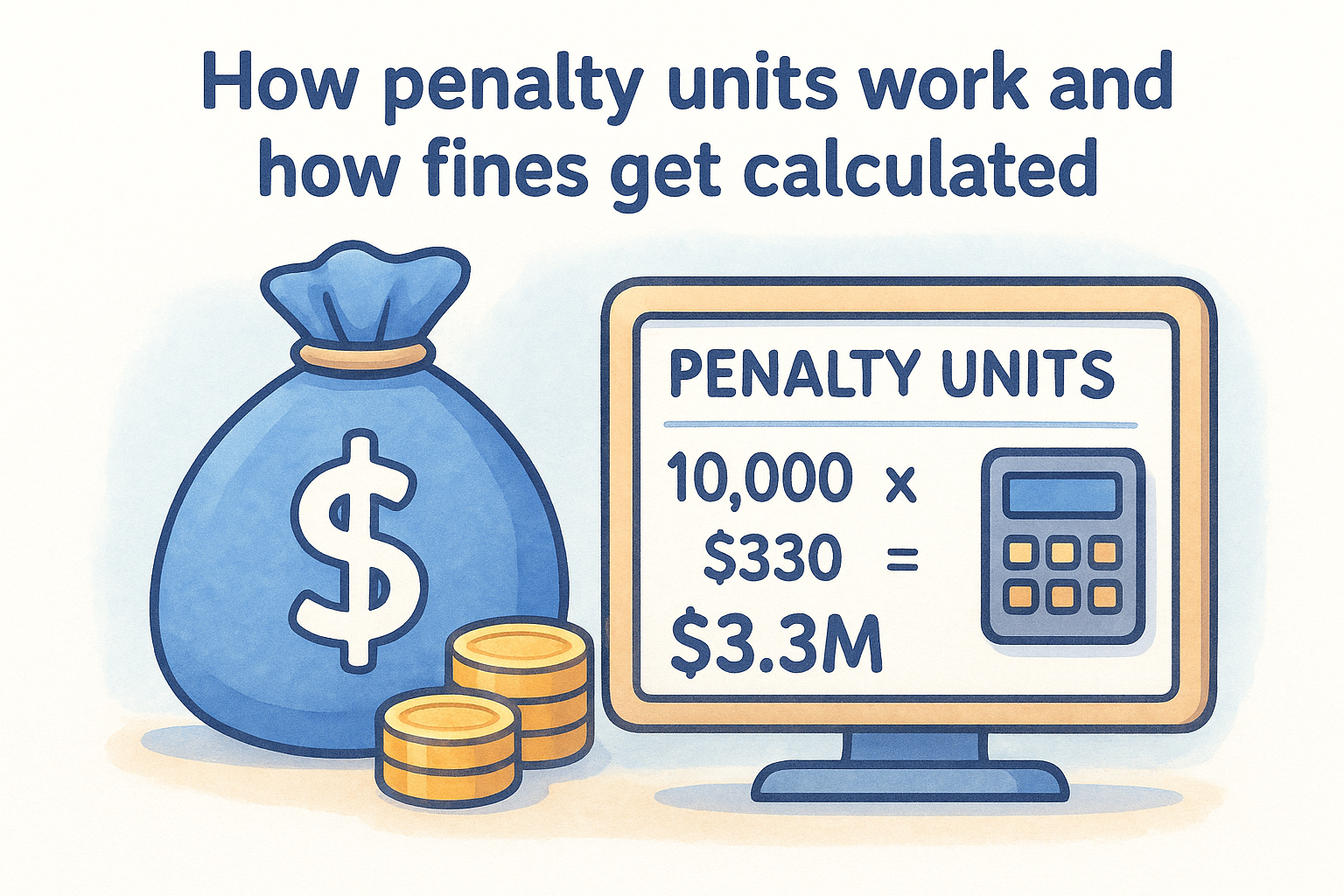
Australia uses penalty units rather than fixed dollar amounts for most regulatory offences, including aml non compliance penalties. This system lets the government adjust penalty values annually without changing the underlying legislation. You face penalties calculated by multiplying the number of penalty units specified in the Act by the current dollar value of a single unit. As of 1 July 2025, one penalty unit equals $330, meaning a 10,000 unit corporate penalty translates to $3.3 million for a single breach.
The annual indexation of penalty units
The Commonwealth adjusts penalty unit values each financial year based on the Consumer Price Index. Your maximum exposure increases automatically without any legislative change or warning beyond the annual government gazette notice. A breach that carried a $3 million maximum five years ago now carries a significantly higher ceiling simply through indexation. This creates a moving target for compliance budgeting, you cannot plan your risk exposure based on historical penalty amounts.
Penalty units automatically increase each year with inflation, meaning your maximum financial exposure to AML breaches grows without any change to the underlying legislation.
Courts and regulators apply the penalty unit value that was current when you committed the breach, not when AUSTRAC discovered it or imposed the penalty. This timing distinction matters because investigations often take years. You might commit a breach in 2024 but face an enforcement action in 2027, with penalties calculated using 2024’s lower unit value.
How AUSTRAC determines actual penalty amounts
AUSTRAC considers your breach history as the primary factor when calculating penalties. First-time violations typically result in lower penalties than repeated failures, especially if you’ve received previous warnings or undertakings. The regulator also weighs the number of affected transactions, the duration of your non-compliance, and whether you self-reported the breach before AUSTRAC discovered it.
Your cooperation during investigation directly influences the final penalty amount. Businesses that provide complete documentation, acknowledge their failures, and implement remediation measures quickly typically receive substantially reduced penalties. AUSTRAC publishes its enforcement approach, showing it routinely applies discounts of 30-50% for genuine cooperation and early admission. Conversely, obstructing investigations or destroying records leads to penalty increases and potential criminal referrals.
The size of your business affects penalty calculations through a proportionality assessment. AUSTRAC scales penalties to ensure they create genuine deterrence without destroying viable businesses. However, this doesn’t mean small firms escape significant fines, a penalty that represents 2% of a large bank’s revenue might represent 20% of your firm’s revenue and still be considered proportionate.
Criminal liability and personal exposure for directors
Your position as a director or senior manager doesn’t shield you from personal criminal charges when your business breaches AML obligations. The Act explicitly targets individuals who exercise control over compliance systems, regardless of whether the corporate entity also faces penalties. You can receive a criminal conviction and imprisonment while your company simultaneously pays civil penalties for the same breach. AUSTRAC and prosecutors treat personal liability as separate from corporate liability, meaning you cannot hide behind your company structure when serious violations occur.
When directors face personal criminal charges
Prosecutors pursue criminal charges against directors when they can demonstrate you knew about compliance failures and either authorised them or failed to prevent them despite having the power to do so. The Act creates a legal presumption that directors are involved in corporate decisions unless you can prove otherwise. This reversal of the burden of proof makes your documentation of compliance oversight critically important. If you cannot produce evidence showing you took reasonable steps to ensure compliance, courts presume you bear responsibility for the breach.
Your personal liability extends beyond direct orders. Courts have convicted directors who created corporate cultures that discouraged proper AML compliance, even when those directors never explicitly instructed staff to breach the law. If you pressure employees to onboard clients quickly without proper verification, or if you fail to resource compliance functions adequately, prosecutors can argue you facilitated the breach through negligence or recklessness.
Directors face personal criminal liability for AML breaches when they knew about compliance failures and failed to prevent them, regardless of whether they directly ordered staff to breach the law.
Corporate veil doesn’t protect you from AML breaches
The standard corporate law protections that separate your personal assets from business liabilities do not apply to aml non compliance penalties under criminal provisions. Your house, personal savings, and other assets become exposed when you face criminal charges for AML violations. Courts can impose personal fines in addition to imprisonment, and these fines are not dischargeable through bankruptcy or corporate insolvency.
Professional consequences compound your financial and criminal exposure. Your accounting or legal professional body will typically suspend or cancel your registration following an AML criminal conviction. You lose your ability to practice in your profession, making the conviction a career-ending event regardless of whether you serve actual prison time. Directors of reporting entities cannot dismiss these risks as theoretical, AUSTRAC has successfully prosecuted individuals in multiple industries, establishing clear precedent for personal accountability.
What AUSTRAC can do besides fines
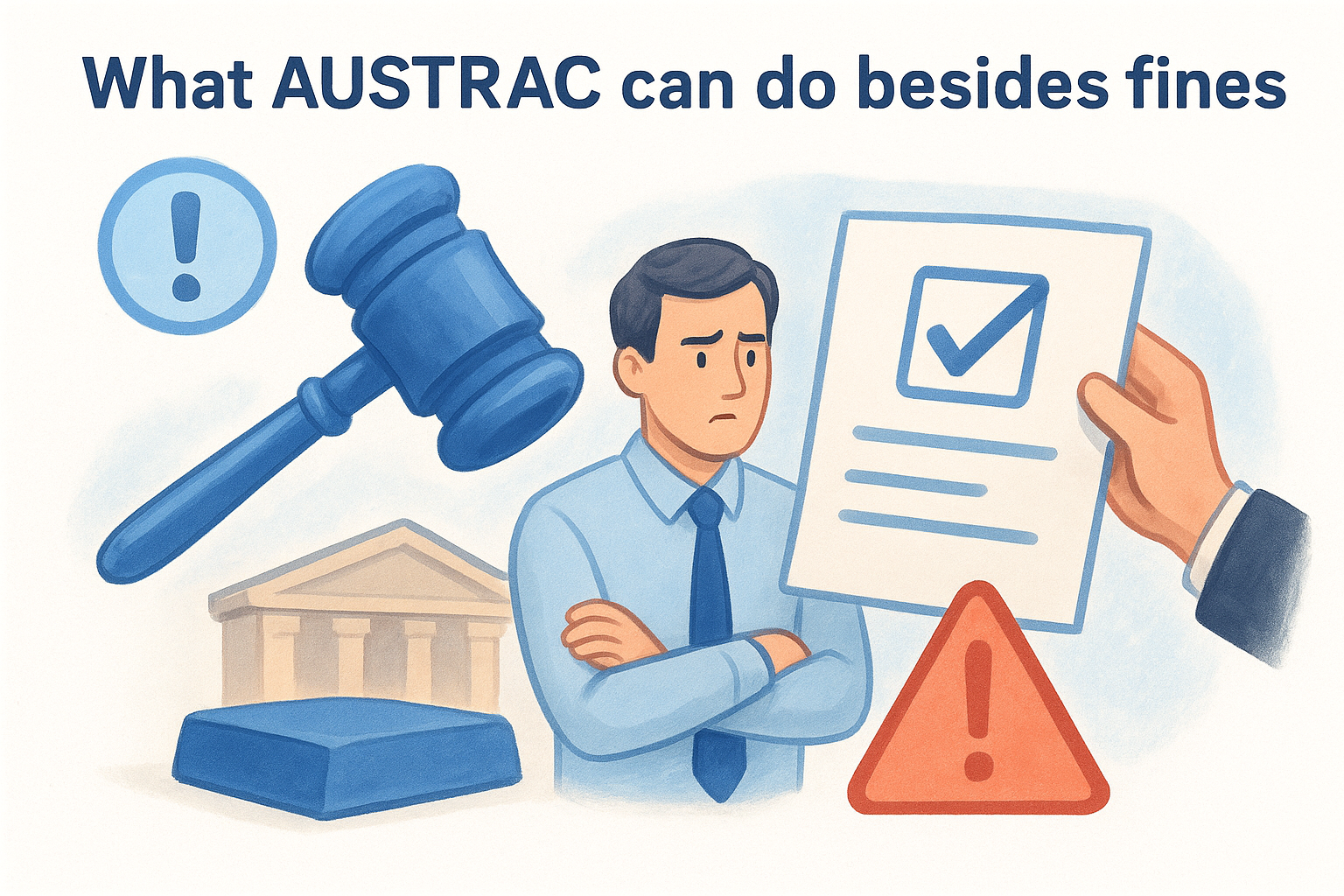
AUSTRAC wields enforcement tools that can shut down your business without ever imposing a dollar in aml non compliance penalties. Regulators prefer these administrative measures because they bypass lengthy court processes and create immediate compliance pressure. Your business faces operational paralysis when AUSTRAC exercises these powers, making them often more damaging than financial penalties. Understanding what the regulator can do beyond fines helps you recognise the full scope of enforcement risk you face.
Enforceable undertakings and compliance orders
AUSTRAC can require you to sign an enforceable undertaking that commits your business to specific compliance improvements within set timeframes. These undertakings become legally binding contracts that the regulator can enforce through courts if you fail to meet your commitments. You might need to hire external auditors, implement new systems, retrain all staff, or appoint an independent compliance monitor who reports directly to AUSTRAC. The costs of meeting an undertaking typically exceed any fine you would have received for the original breach.
Enforceable undertakings force businesses to make specific compliance improvements at their own expense, creating ongoing costs that often exceed the financial penalties for the original breach.
Courts can also issue compliance orders that compel you to take specific actions or cease certain business activities. Unlike undertakings that you voluntarily agree to, compliance orders are imposed on you through judicial process. Breaching a compliance order creates contempt of court charges on top of your original AML violations, escalating both your legal exposure and your enforcement priority with AUSTRAC.
Suspension or cancellation of registration
Your reporting entity registration can be suspended or cancelled entirely when AUSTRAC determines you cannot meet your obligations. Suspension freezes your ability to provide designated services, meaning you cannot onboard new clients or conduct certain transactions with existing clients. Your business continues operating in a limited capacity, but revenue streams dependent on those designated services stop immediately. Cancellation removes your registration permanently, forcing you to cease all reporting entity activities.
Reinstatement after suspension or cancellation requires demonstrating comprehensive compliance improvements to AUSTRAC’s satisfaction. The regulator demands evidence of system upgrades, staff training, independent audits, and often ongoing external compliance monitoring. This process takes months or years while your competitors capture your market share.
Public naming and disclosure
AUSTRAC publishes enforcement actions on its website with full details of your compliance failures and the penalties imposed. This public disclosure creates reputational damage that persists long after you’ve paid any fines or completed undertakings. Clients, partners, and suppliers discover your enforcement history through simple searches, affecting your business relationships for years. Media outlets regularly report on AUSTRAC enforcement actions, amplifying the reputational impact beyond the regulator’s own disclosures.
How to avoid breaches and respond if AUSTRAC contacts you
Prevention costs a fraction of what you’ll pay in aml non compliance penalties and remediation expenses. Your compliance strategy should focus on integrating verification directly into your existing client onboarding workflows rather than bolting on separate systems after the fact. Most breaches occur because firms treat AML obligations as an administrative checkbox rather than embedding them into their core business processes. When verification happens automatically as part of how you already work, you eliminate the human error and workflow gaps that trigger AUSTRAC enforcement actions.
Build verification into your existing systems
Your CRM or practice management software should trigger identity verification automatically when you create a new client record. Manual processes fail because staff forget steps, rush through busy periods, or misunderstand requirements. Integration eliminates these failure points by making compliance impossible to skip. You need verification to complete before the system allows you to progress the client relationship, creating a technical control that prevents non-compliance rather than relying on procedural controls that humans can bypass.
Integrating AML verification directly into your existing software makes non-compliance technically impossible, eliminating the human error that causes most breaches.
Choose verification providers that write results back into your existing systems rather than maintaining separate compliance databases. This single source of truth approach ensures your staff see verification status immediately without switching between platforms. Separate systems create gaps where verified clients slip through unrecorded, leaving you exposed when AUSTRAC audits your records.
Document everything from day one
Every verification decision needs a contemporaneous record explaining why you took that action. Courts and regulators scrutinise gaps in documentation as evidence of inadequate processes. You should record who conducted each verification, what checks they performed, what results they obtained, and what risk assessment led to your final decision. This documentation proves you followed proper procedures even when outcomes later prove incorrect.
Retain all source documents and system logs for at least seven years. AUSTRAC investigations often examine breaches that occurred years before detection. Missing documentation from historical clients creates presumptions of non-compliance that you cannot rebut.
What to do when AUSTRAC contacts you
Contact a lawyer immediately before responding to any AUSTRAC inquiry or notice. Your initial response shapes the entire investigation trajectory. Admitting facts without understanding their legal implications can transform a minor compliance question into a major enforcement action. Legal advice ensures you provide required information without inadvertently expanding your liability exposure.
Preserve all relevant documents and system records as soon as you receive contact from AUSTRAC. Your legal obligation to maintain evidence begins when you know an investigation might occur. Destroying or altering records after AUSTRAC contact constitutes obstruction and triggers criminal charges separate from your original breach.
Key takeaways and next steps
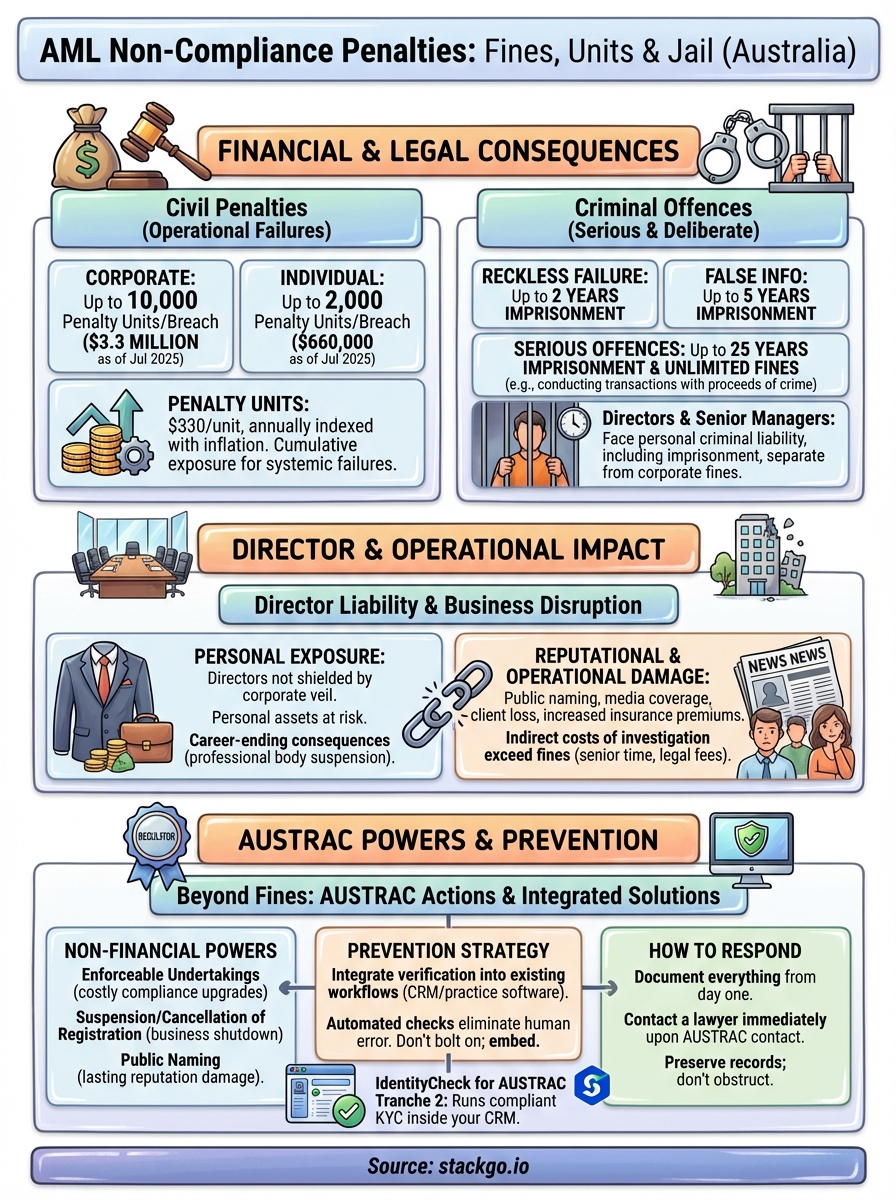
AML non compliance penalties in Australia represent genuine business-ending risks, with corporate fines reaching $3.3 million per breach, individual fines up to $660,000, and prison sentences extending to 25 years for serious violations. AUSTRAC can suspend your registration, publicly name your firm, and impose enforceable undertakings that cost more than the original fine. Your directors face personal criminal liability that pierces corporate protections, making this a board-level risk that demands immediate action.
Prevention requires embedding verification into your existing systems rather than adding manual checks that staff can skip. StackGo’s IdentityCheck for AUSTRAC Tranche 2 runs compliant KYC verification directly inside your CRM or practice management software, creating technical controls that prevent breaches before they occur. You verify clients automatically as part of your normal onboarding workflow, with all results written back to your existing system. Start your compliance preparation now, waiting until AUSTRAC enforcement begins guarantees you’ll be playing catch-up while exposed to penalties.


