

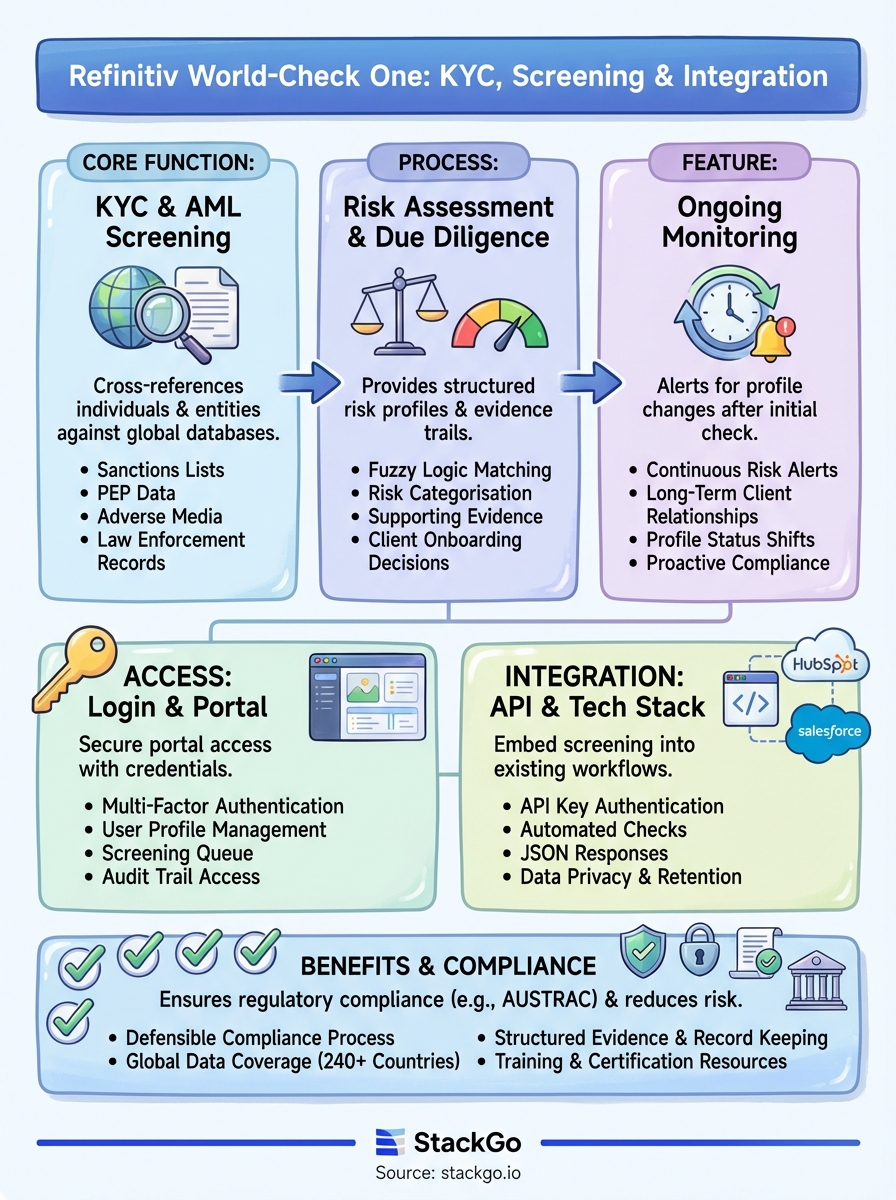
Refinitiv World-Check One is one of the most widely referenced screening databases in KYC and AML compliance, used by banks, professional services firms, and regulated businesses globally. It cross-references individuals and entities against sanctions lists, politically exposed persons (PEP) data, and adverse media, giving compliance teams a structured way to assess risk before onboarding a client.
But knowing what World-Check One does is only half the picture. If you’re evaluating it for your firm, you’ll want to understand how its API works, what the login and portal experience looks like, and whether it fits into your existing tech stack, or whether it creates yet another disconnected tool your team has to manage. That’s a problem we solve at StackGo, where our integration platform embeds identity verification and screening directly into the software you already use, like HubSpot or Salesforce.
This article breaks down World-Check One’s core screening capabilities, its API documentation, training resources, and how it compares to integrated approaches for firms that need compliance without the complexity.
Why World-Check One matters for KYC and AML
For any regulated business, the risk of onboarding a sanctioned individual, a PEP, or someone linked to financial crime is not theoretical. Regulators in Australia and globally expect you to demonstrate that you conducted meaningful due diligence before a client relationship begins. World-Check One gives compliance teams a centralised reference point to do exactly that, pulling together data that would otherwise require checking multiple fragmented sources manually.
The scope of the data
Refinitiv World-Check One draws on thousands of sources, including government sanctions lists, law enforcement records, regulatory watchlists, and adverse media, to build structured risk profiles on individuals and entities. The database covers over 240 countries and territories, which matters if your firm services clients internationally. Rather than relying on a single government list, it aggregates and organises data so your compliance team can run one check and get a consolidated risk picture.
The breadth of World-Check One’s data coverage is one reason it has become a reference standard for banks and professional services firms managing cross-border client risk.
The regulatory pressure behind it
Australian firms face increasing compliance obligations. AUSTRAC’s AML/CTF framework requires designated businesses to identify, assess, and monitor the risk of money laundering and terrorism financing tied to their customers. From 2026, the expanded regime will bring accountants, lawyers, and real estate agents directly under those rules. Failing to screen clients adequately can result in civil penalties, criminal liability, and reputational damage that is difficult to recover from.
Using a structured database like World-Check One helps you build a defensible, documented compliance process rather than relying on informal checks that leave your firm exposed. It is not just about ticking a box; it is about maintaining a clear record of what you checked and when.
How World-Check One screening works
When you run a check, Refinitiv World-Check One matches the name and details you submit against its structured database of risk profiles, sanctions lists, and PEP records. The matching engine uses fuzzy logic to catch name variations, spelling differences, and aliases, which reduces the chance of a genuine hit slipping through because someone’s name appears differently across documents.
What a screening result looks like
Each result returns a risk category and a supporting evidence trail drawn from the original sources. You typically see the individual’s or entity’s flagged connections, the specific list they appear on, and the date the record was last updated. Reviewing that evidence is your responsibility; World-Check One surfaces the data, but your compliance team makes the final risk determination and documents it.
The platform does not make the compliance decision for you; it gives your team the structured evidence needed to make that call themselves.
Ongoing monitoring
Beyond one-off checks, World-Check One supports continuous monitoring, sending alerts when a previously screened individual’s risk profile changes. This is particularly important for long-term client relationships, where someone’s sanctions status or PEP classification can shift well after your initial onboarding check was completed.
How to log in and run a basic screening
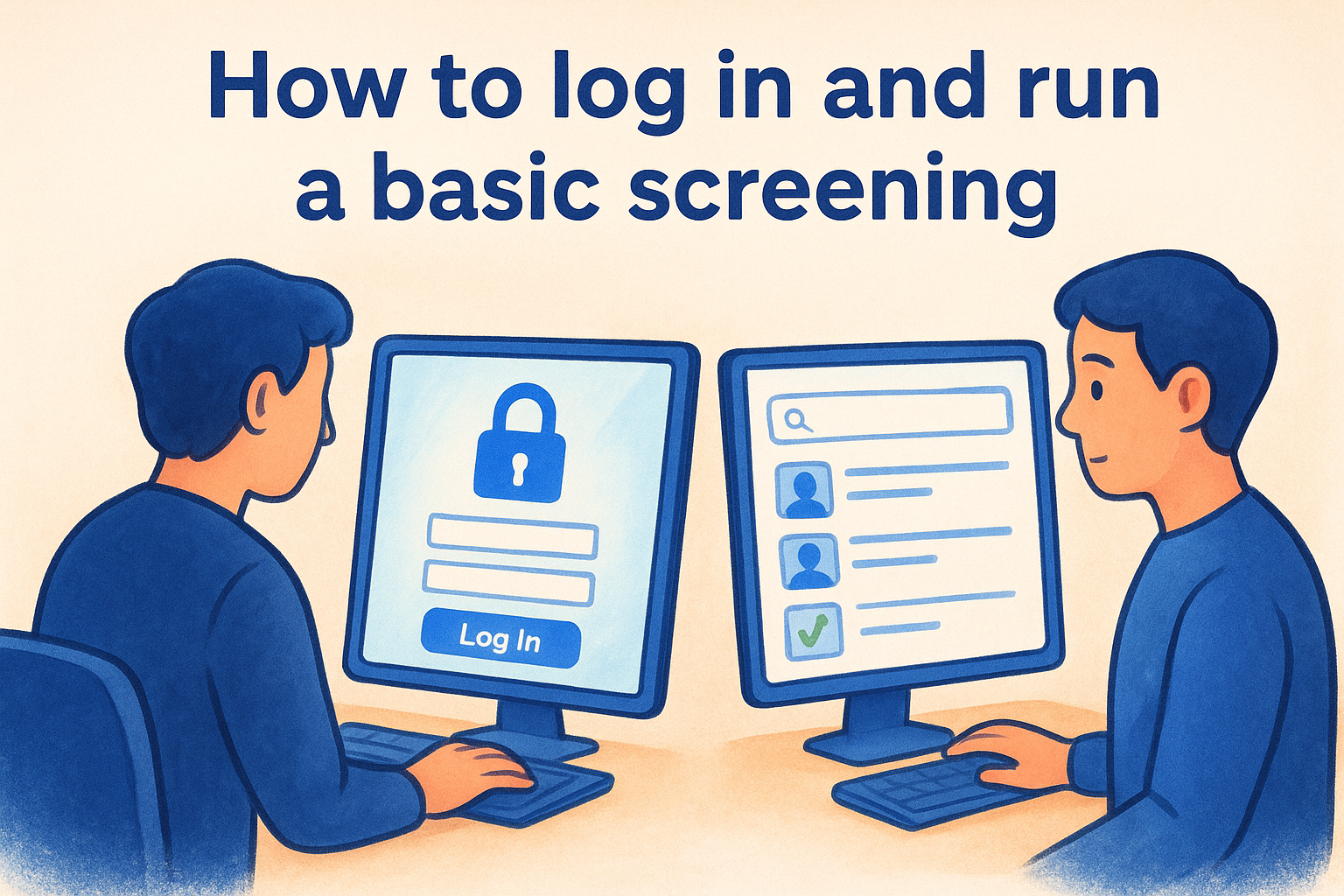
You access Refinitiv World-Check One through the client portal, which requires credentials issued when your organisation subscribes. Your account administrator sets up user profiles and assigns permissions, so if you cannot log in, the first step is confirming your access level internally before contacting Refinitiv support.
Accessing the portal
Your login URL and credentials come from your Refinitiv account setup, typically shared during onboarding. Once inside, the dashboard gives you access to your screening queue, saved searches, and monitoring alerts. Multi-factor authentication is standard, so keep your registered device available when logging in.
If your team members need separate access, your administrator can provision individual accounts rather than sharing a single login, which also gives you a cleaner audit trail.
Running your first check
To run a basic screening, you enter the individual’s full name, date of birth, and country of residence into the search fields. The platform returns any matching risk profiles along with their source records. From there, your compliance team reviews the evidence, makes a risk determination, and documents the outcome. That documentation step is as important as the check itself for regulatory purposes.
World-Check One API: what to know before integrating
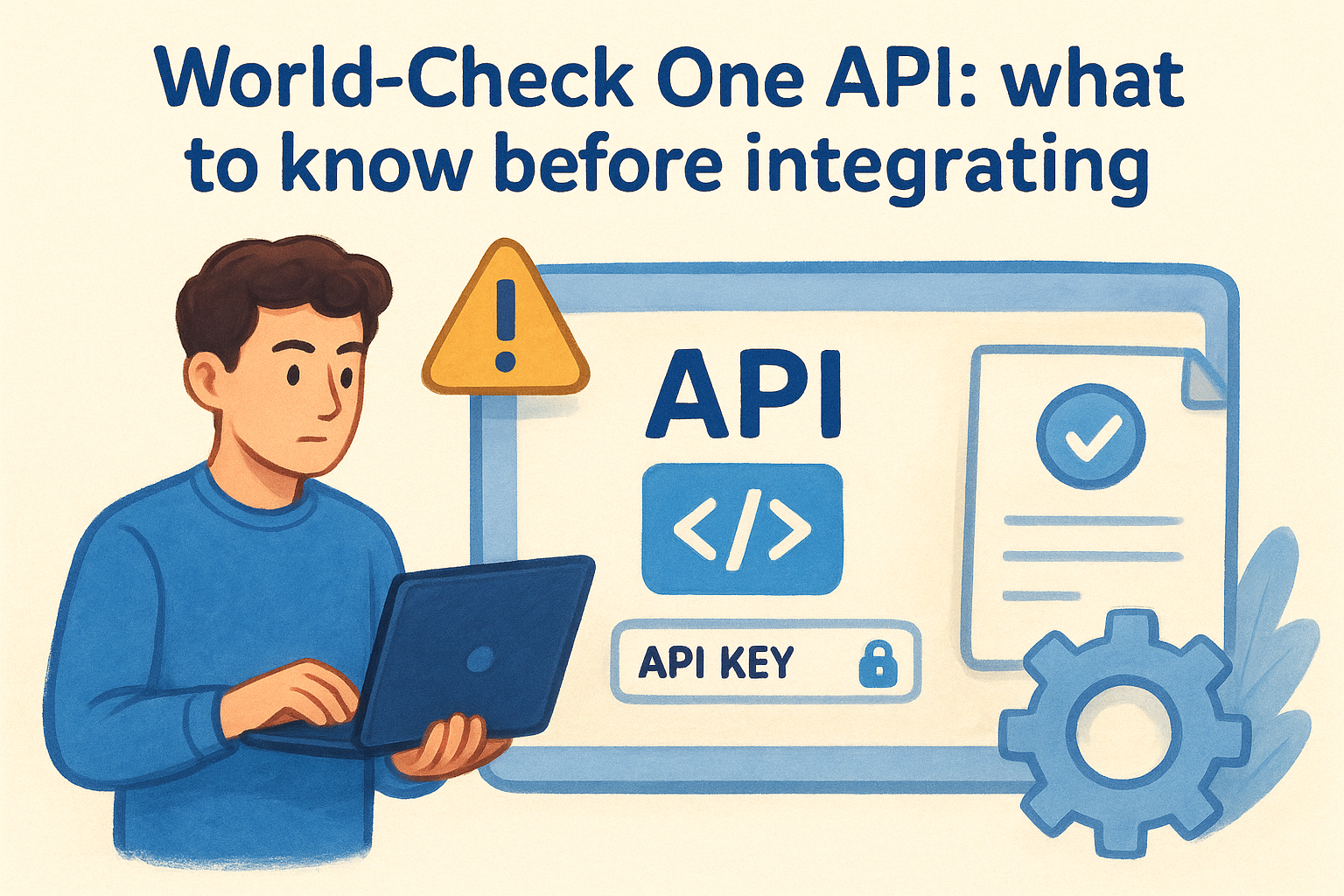
The Refinitiv World-Check One API lets you embed screening directly into your own applications, automating checks without requiring your team to log into the portal manually. Before you start building, there are a few practical realities worth understanding.
Authentication and request structure
Access to the API requires API key authentication, which Refinitiv provisions through your account setup. Each request passes the candidate’s details, such as name, date of birth, and country, and returns structured JSON responses containing matching risk profiles and source references. You will need to handle response parsing and risk-decision logic on your end.
Build your integration to log every API request and response, since that audit trail forms part of your compliance documentation.
Rate limits and data handling
The API applies rate limits based on your subscription tier, so high-volume screening workflows need careful planning around batch sizes and request timing. You also need to consider how you store or pass the returned data, since privacy obligations apply to information you retrieve, not just information you submit. Your data retention policies should account for screening results the same way they account for other personal information held across your systems.
Training, certification, and common pitfalls
Refinitiv offers training resources and certification pathways through its learning portal, accessible once your organisation holds an active subscription. Working through these materials helps your compliance staff understand how to interpret screening results and document decisions in a way that satisfies regulatory expectations.
Getting trained on the platform
The Refinitiv World-Check One learning materials cover both platform navigation and the underlying compliance concepts that drive the screening logic. Completing the available certification gives your team a documented baseline of competency that supports your broader compliance program when regulators ask how staff are qualified.
Key areas the training covers include:
- Interpreting risk categories and source records correctly
- Applying the matching logic to catch aliases and name variations
- Documenting risk determinations for audit purposes
Pitfalls to avoid
The most common mistake is treating a no-match result as a clean bill of health. A result with no hits means the individual does not appear in the database at that point in time; it does not guarantee there is no underlying risk.
Documenting your risk decision alongside every screening result protects your firm far more than the check alone.
Ongoing monitoring closes this gap by alerting your team when a previously screened profile changes status after your initial check is complete.
Where to go from here
Refinitiv World-Check One gives your compliance team a structured, defensible way to screen clients against sanctions lists, PEP records, and adverse media. Understanding how to log in, interpret results, use the API, and train your staff puts you in a much stronger position when regulators ask how you manage client risk.
That said, the platform works best when it fits into how your team already operates. If your firm is managing KYC and AML screening outside your core systems, you are adding manual steps and friction that compound over time. StackGo’s IdentityCheck embeds identity verification and screening directly into the software you already use, removing the need to jump between tools or rebuild your workflow.
If your firm is preparing for AUSTRAC’s expanded obligations, see how IdentityCheck handles Tranche 2 AML/CTF compliance inside your existing tech stack.


